Visual Identification Guide to Ludwigia peploides
A stage-by-stage visual guide to identifying Ludwigia peploides at every phenological stage — from seedling emergence through mature mat, flowering, fruiting, and winter dormancy.
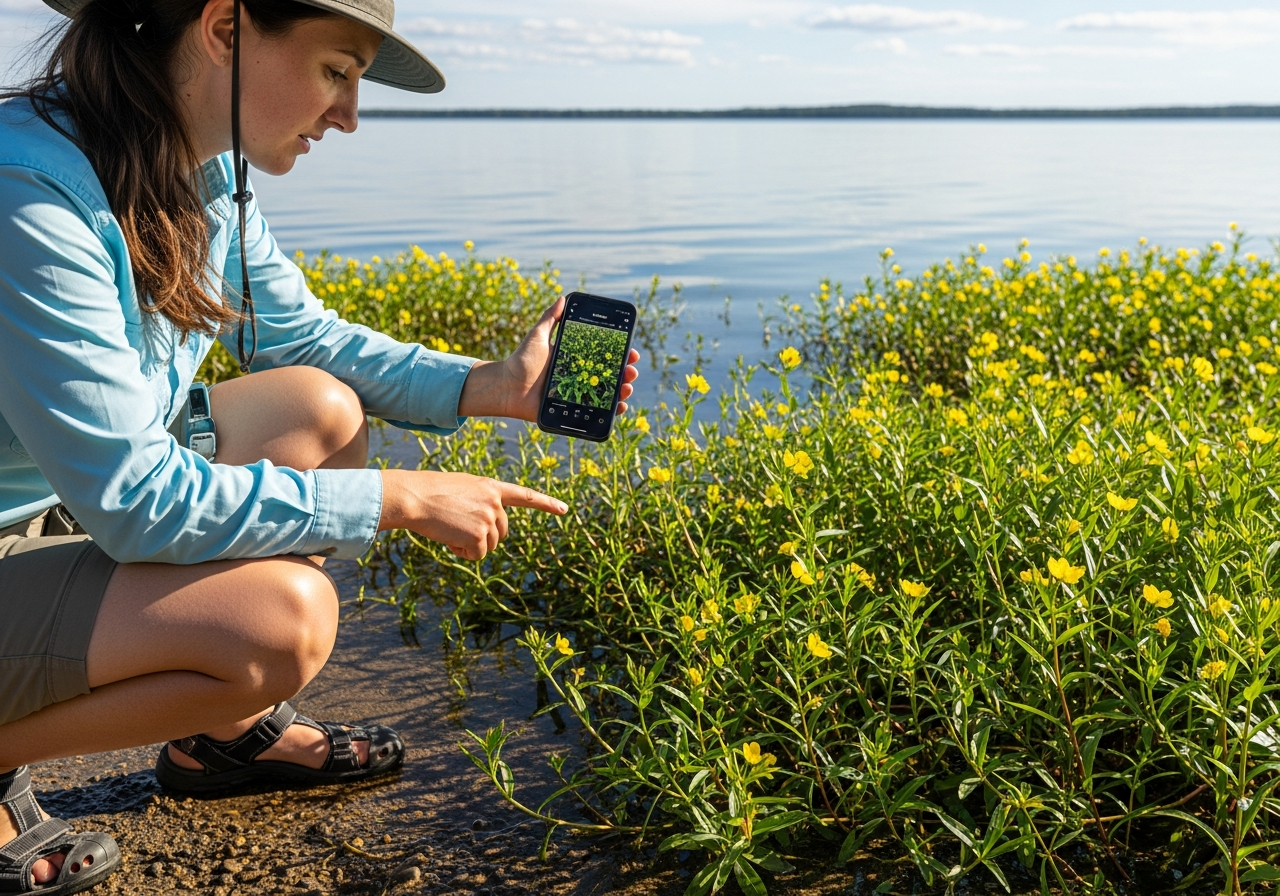
Ludwigia peploides presents very differently depending on the time of year and the life stage being observed. Ecologists monitoring for new infestations, water managers surveying treatment sites, and citizens reporting suspected occurrences all benefit from understanding what the plant looks like at each stage. This guide covers every major phenological phase with diagnostic notes and visual cues for each. For a feature-by-feature morphological guide, see How to Identify Creeping Water Primrose.
Seedling Stage
Seeds germinate in spring when soil temperatures reach 15–20°C. The cotyledons (seed leaves) are small (2–4 mm), oval, and pale green. The first true leaves appear within 1–2 weeks and are already alternate, oval to oblong, and slightly shiny. Seedlings at 2–5 cm height grow in moist or wet sediment — typically at the margins of water bodies or in recently exposed mudflats. They are inconspicuous at this stage and easily overlooked. Detection at the seedling stage is primarily achieved through systematic sediment surveys or environmental DNA sampling of the water column. Confirming seedling identity requires either flower observation (impossible at this stage) or genetic analysis.
Juvenile Mat Stage
As temperatures rise in spring, growth accelerates. Stems elongate rapidly, reaching 10–50 cm, and begin to extend over the water surface or float. At this stage, all key vegetative identification features are reliably present: alternate shiny leaves, nodal rooting with developing pneumatophores, and the characteristic creeping/floating habit. Stems are typically bright green, sometimes with reddish tinges in high-light conditions. This is the optimal stage for early intervention — populations are still limited in extent and biomass, making treatment far less costly than at mature stages. For information on early-stage management costs, see our Cost of Inaction analysis.
Mature Vegetative Growth
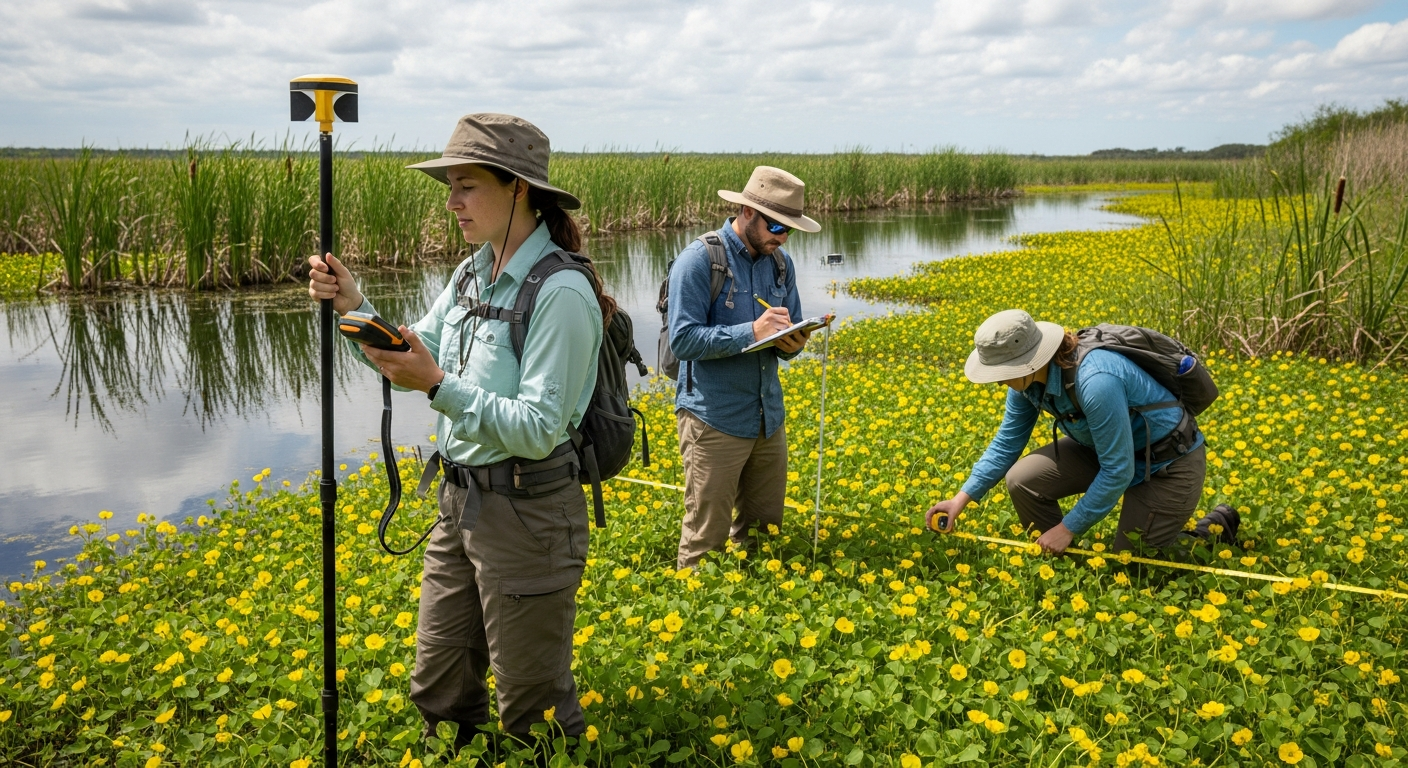
By early summer, stems may reach 1–3 m in length, forming a continuous mat over open water. The mat surface is a dense mosaic of shiny leaves, with erect shoot tips emerging 30–80 cm above the waterline. Pneumatophores are abundant at all submerged or semi-submerged nodes. From above, a mature mat is nearly impenetrable — the density of leaf coverage typically exceeds 80–90% in established infestations. The mat structure supports its own microclimate — warmer and more humid than the open water adjacent to it — which further promotes growth.
Flowering Stage
Flowering peaks from late spring to late summer (May–September in temperate North America, March–November in warmer regions). Individual flowers last 1–3 days, but mature plants produce dozens of flowers per week, creating a continuously renewed floral display. The flowers — bright golden-yellow, 4–6 cm across, with 5 rounded petals — are one of the most visually striking features of the species and make summer identification straightforward. Bumblebees are the primary pollinators; patches often have a characteristic buzzing sound from pollinator activity. Each flower produces a cylindrical seed capsule 1–3 cm long that matures over 3–6 weeks. See Flower Identification details for more on the floral anatomy.
Fruiting and Senescence
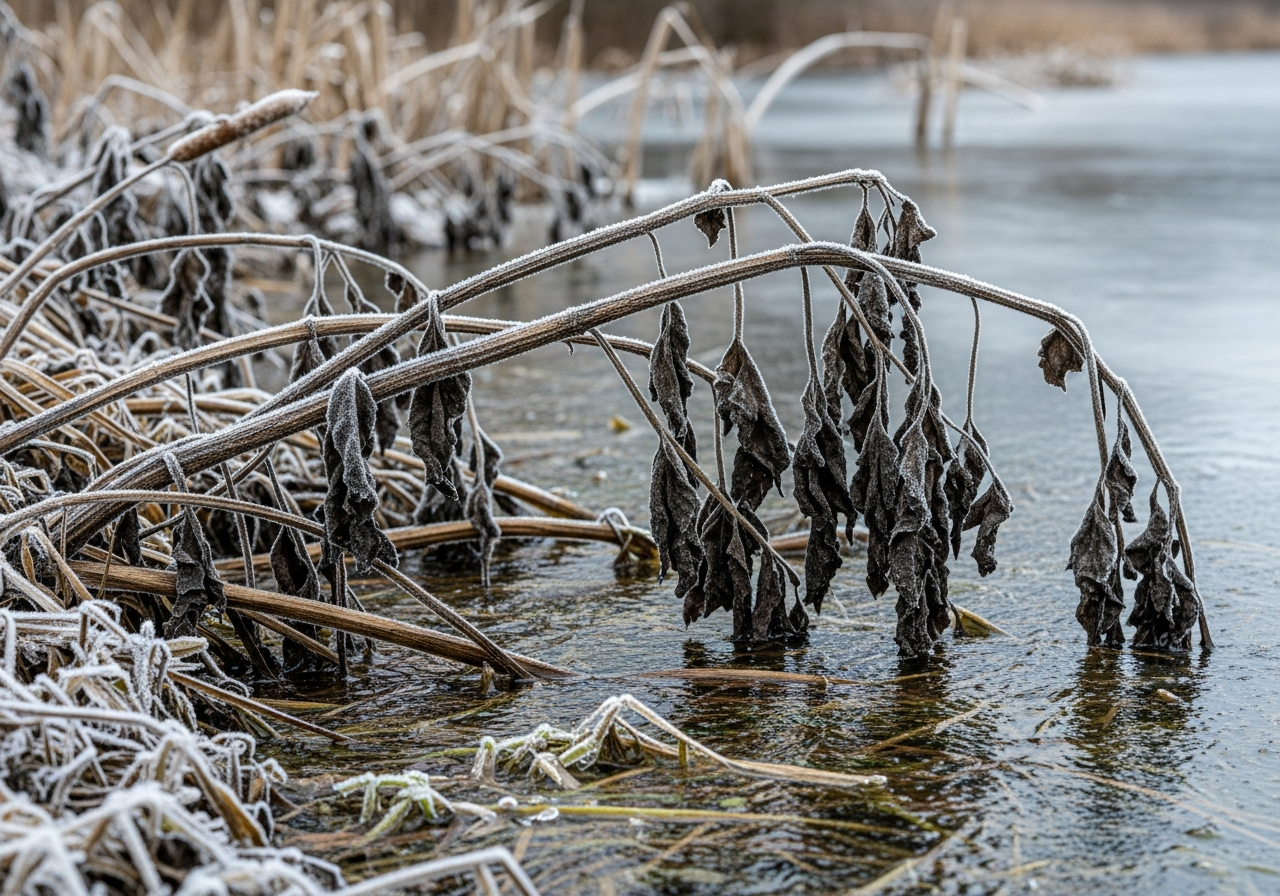
In autumn, as temperatures decline and day length shortens, growth slows and flowering ceases. The leaves take on a reddish or bronze hue before yellowing and dying back. Seed capsules ripen and begin to dehisce, releasing seeds into the water. The mat progressively flattens as stems lose structural support and die. In the most advanced senescence, the mat becomes a mat of brown, fibrous, interlocked dead stems floating on the water surface. This dead mat material retains seeds and may persist through winter, releasing seeds into the sediment bank where they persist for multiple years.
Winter Condition
In temperate regions (hardiness zone 7 and below), aerial growth typically dies completely in winter frosts. However, root crowns and rhizome fragments in the sediment or along banks often survive and regenerate vigorous new growth the following spring. In mild-winter regions (zones 8–12), basal shoots may remain green through winter and resume active growth very early in spring — often before monitoring surveys begin in early spring. This gives established plants a head start over newly germinated seedlings and is one reason that multi-year management programs are necessary. See Identifying by Season for a month-by-month guide to seasonal appearance.
Conclusion
Identifying Ludwigia peploides across all life stages requires knowledge of its seasonal phenology and an understanding of which diagnostic features are available at each stage. Flowering plants in summer are the easiest to confirm; vegetative plants in spring and autumn require attention to leaf arrangement, pneumatophores, and growth habit. Winter detection requires sediment surveying or eDNA analysis. Early detection — at the seedling or juvenile mat stage — enables the most cost-effective management responses. If you suspect a new infestation, report it promptly. See our New Invasion Reports guide for reporting resources in your region.