How to Identify Creeping Water Primrose
A step-by-step field guide to the distinctive diagnostic features of Ludwigia peploides — covering flowers, leaves, stems, root structures, and growth habit for accurate identification in any season.
Accurate identification of Ludwigia peploides is the critical first step in any management program — but it is not always straightforward. The plant changes dramatically in appearance between seasons, and several native aquatic species share superficially similar features. This guide walks through each diagnostic characteristic in detail, providing the morphological knowledge needed to confirm identification with confidence in the field. For a broader introduction to the species, see What Is Ludwigia peploides?
Key Diagnostic Features at a Glance
Before examining individual structures in detail, here is a summary of the features that distinguish L. peploides from all common confusion species:
- Flowers: 5 bright yellow petals, 4–6 cm diameter, produced prolifically in summer
- Leaves: Alternate, shiny, oblong-elliptic, 3–12 cm long, smooth margins
- Stems: Creeping/floating, green to red, rooting at nodes
- Pneumatophores: White, spongy protrusions at stem nodes where they contact wet substrate
- Root system: Fibrous adventitious roots at each node
- Fruit: Cylindrical capsule, 1–3 cm long
Leaf Morphology
The leaves of L. peploides are arranged alternately on the stem — never opposite or whorled. Fully expanded leaves are oblong to elliptic in outline, typically 3–12 cm long and 1–4 cm wide, tapering at both ends with a distinct petiole (leaf stalk) 0.5–2 cm long. The upper leaf surface is bright to deep green, smooth, and notably shiny — an important distinguishing character. Leaf margins are entire (smooth) with no teeth or lobes. The midrib and primary veins are clearly visible and slightly pale. In high-light conditions, leaves of emergent shoots develop a distinctive cuticle that gives them a glossy, almost waxy appearance. Submerged leaves, if present, are longer and thinner with less obvious cuticle.
Flowers and Fruits
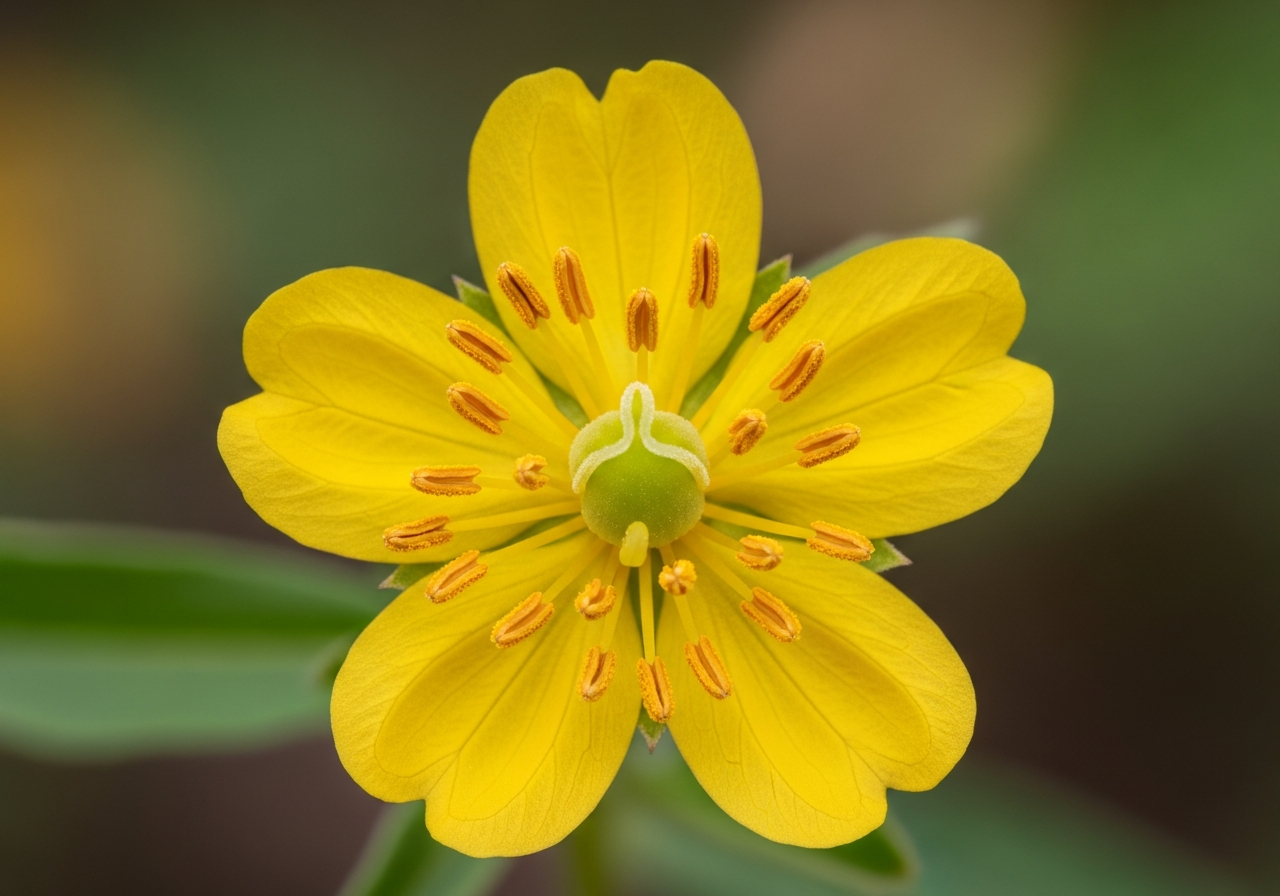
The flowers are the most striking and reliable identification feature. They are borne singly in leaf axils on peduncles (flower stalks) 0.5–3 cm long. Each flower is perfect (bisexual), with 5 bright yellow petals 1.5–2.5 cm long, 5 green sepals of similar length to the petals, 10 stamens in two whorls, and an inferior ovary. The petals are broadly obovate (widest near the tip), sometimes with slightly notched tips. The flowers open in the morning and are visited by bumble bees and solitary bees. The floral display in late spring and summer — when dozens of flowers may be open simultaneously on a single mat — is highly conspicuous and is often the first feature that draws attention to an infestation.
The fruit is a cylindrical capsule, 1–3 cm long, somewhat 5-angled, green initially then brown at maturity, dehiscing irregularly to release numerous tiny seeds. Seeds are embedded in the fruit wall and may remain viable for several years in sediment. For more on reproductive biology, see Ludwigia peploides Reproduction Explained.
Root Structures and Pneumatophores
Perhaps the most diagnostic identification feature at the vegetative stage is the pneumatophores — white, spongy, finger-like protrusions that develop at stem nodes wherever stems are in contact with wet substrate or float on water. These structures are composed of aerenchyma tissue — interconnected air spaces that facilitate oxygen transport to submerged root systems. They are typically 1–4 cm long, pure white, and have a soft, compressible texture distinctly unlike typical root tissue. No common native species produces comparable structures at stem nodes in aquatic environments, making pneumatophores a near-definitive identification character.
Growth Habit
The characteristic growth form is a creeping or floating mat. Stems radiate from a rooted crown, spreading horizontally across the water surface or along muddy margins. Individual stems can reach 3 m or more in length in a single growing season. Where stems reach shallow water or bank edges, they root at nodes and produce erect or ascending shoot tips that emerge up to 1 m above the water surface. This combination of floating mat and erect emergent shoots creates a characteristic "hummock" appearance in mature infestations. In river systems with moderate flow, floating mats may detach and travel downstream, establishing new infestations at points of deposition. See our article on Invasive Spread Patterns of Ludwigia peploides for more on downstream dispersal dynamics.
Confirming Your Identification
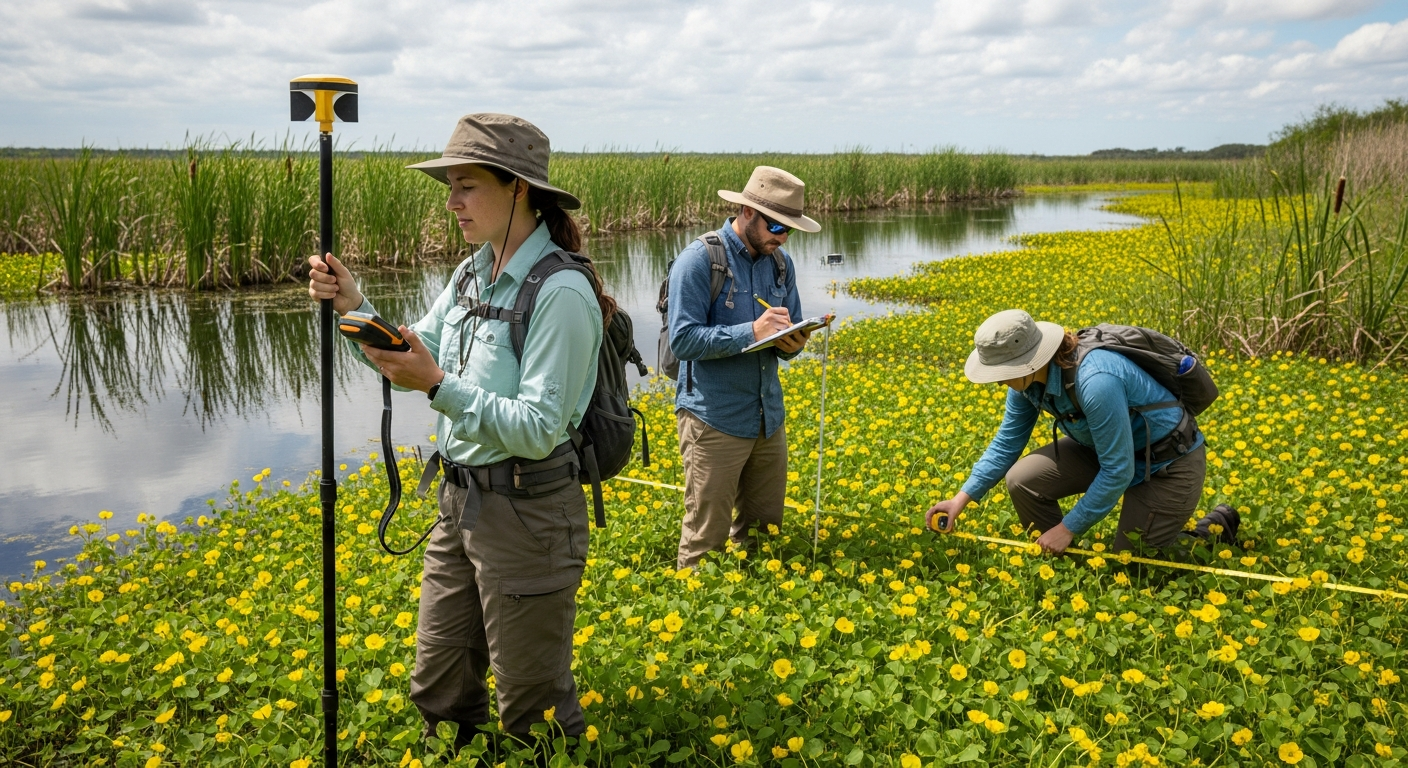
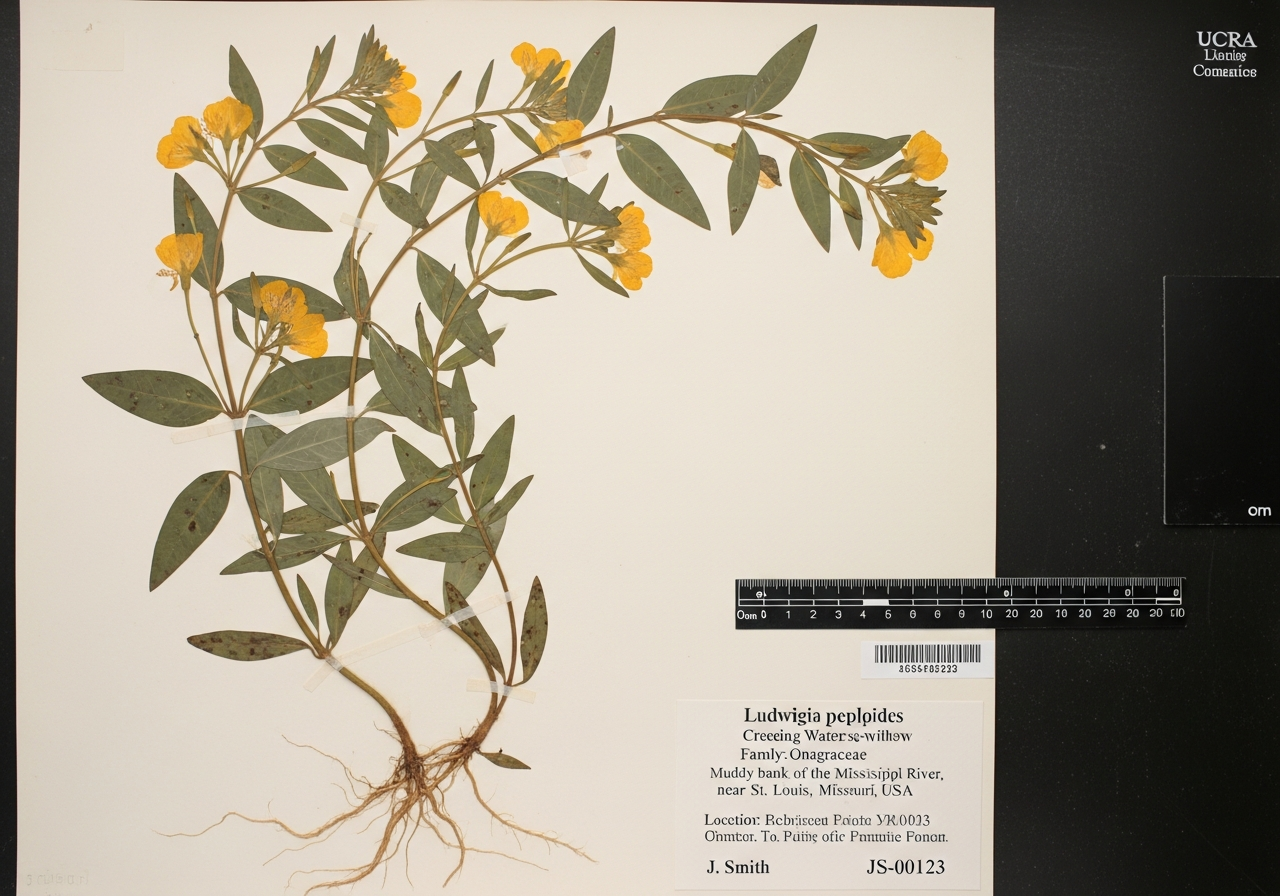
After applying morphological keys, report suspected new infestations through your state invasive species reporting program or through iNaturalist with GPS coordinates and photographs of leaves, stems, flowers (or fruit), and the pneumatophores. For professional confirmation, herbarium voucher specimens (pressed and dried plant material) can be submitted to a regional herbarium with full collection data. Environmental DNA sampling of water samples from suspected sites can also provide molecular confirmation of presence without requiring plant collection — a particularly valuable approach for early-season detection. See our guide to Early Stage Identification for eDNA and other advanced detection methods.
Conclusion
Creeping Water Primrose is identifiable with reasonable certainty using vegetative features alone — particularly the alternate shiny leaves, creeping/floating stem with nodal rooting, and characteristic white pneumatophores. Adding flower observation in summer provides definitive confirmation. When uncertain, compare carefully with the native look-alike species in our Ludwigia vs Native Plants guide, and when in doubt, seek expert confirmation before initiating treatment.