Invasive Spread Patterns of Ludwigia peploides
How Ludwigia peploides expands within water bodies and moves between them — the ecology of local spread, downstream dispersal, wildlife-mediated transport, and human-assisted movement.
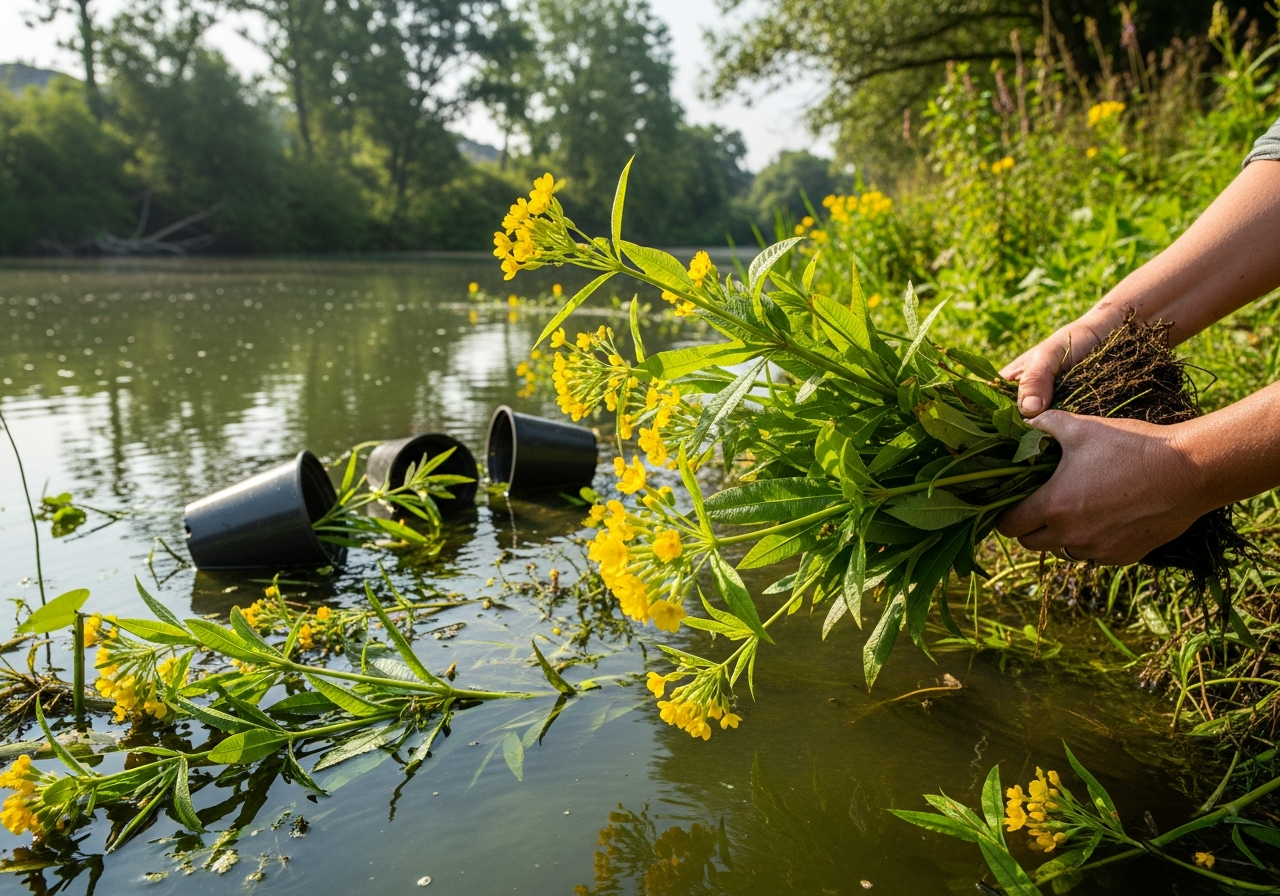
Understanding how Ludwigia peploides spreads — both within water bodies and between them — is essential for designing effective prevention and management programs. The species employs multiple dispersal mechanisms simultaneously, which is a key reason why containment is so difficult once an infestation is established. This article examines each spread mechanism in detail and discusses the practical implications for management. For information on specific invasion corridors, see our Predictive Risk Mapping article.
Local Spread Within Water Bodies
Within a single water body, L. peploides expands primarily through vegetative growth — stem elongation and nodal rooting. Stems grow at rates of up to 5–15 cm per day in warm, nutrient-rich conditions, radiating outward from rooted crowns to cover progressively larger areas of open water. When elongating stems reach the far shore, riverbank, or other emergent vegetation, they root at the new contact point and establish a new vegetative crown. This clonal expansion can convert an entire small pond or canal reach from open water to a closed mat within two to three growing seasons. In larger water bodies, mat expansion is limited by wave disturbance, water depth, and competition from other vegetation, but even in larger lakes, sheltered bays and margins can be fully occupied within a few years of initial establishment.
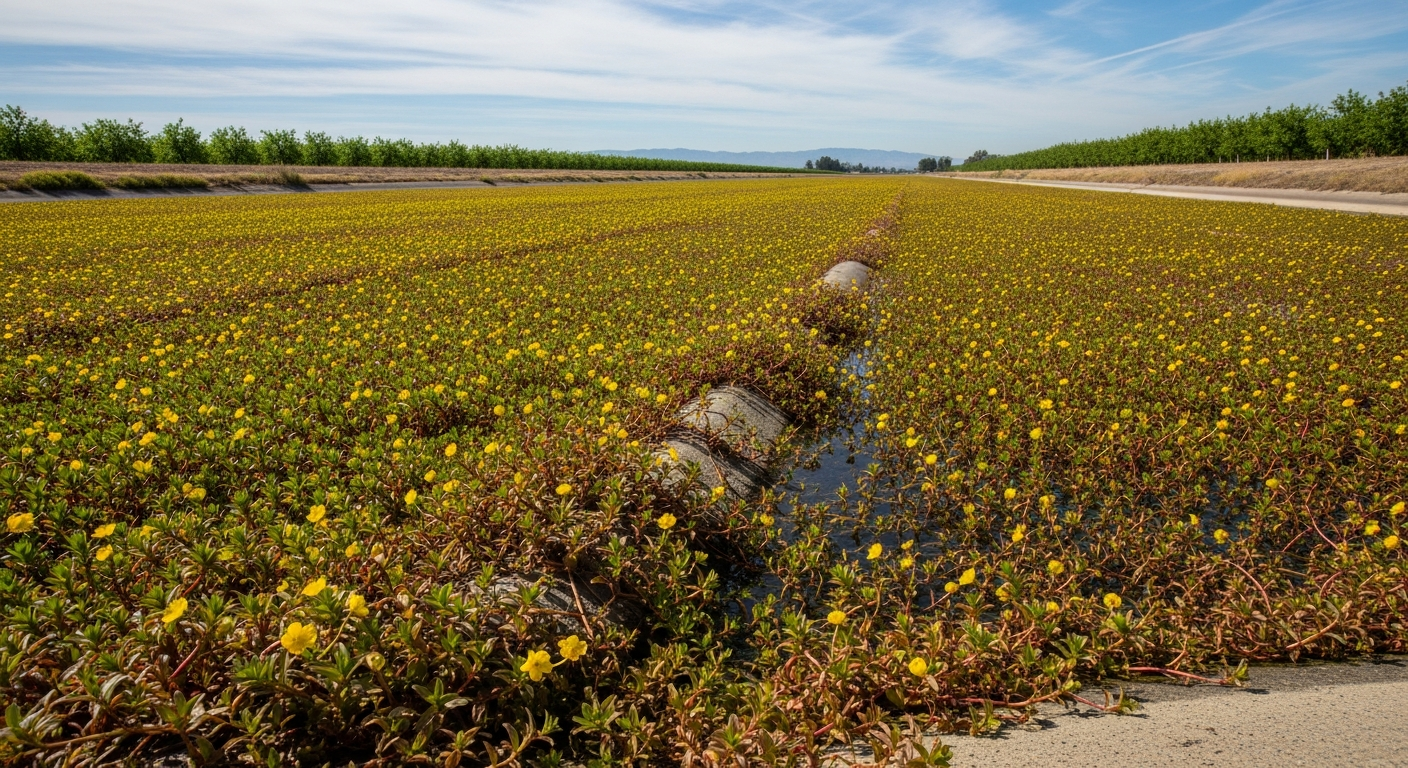
Regional Dispersal Along Waterways
Between connected water bodies along river systems, L. peploides spreads primarily by downstream transport of stem fragments. Fragments are generated continuously from the margins of established mats — through wave action, boat wash, flooding, or management activities. A single internode (the section of stem between two nodes) can root and establish a new plant, so even small fragments (5–10 cm) are viable propagules. Fragments remain buoyant and viable in water for weeks to months — long enough to travel considerable distances downstream in most river systems. In river networks, this produces a characteristic downstream colonization pattern where infestations appear first at slack-water features (bends, backwaters, confluences, behind structures) downstream of established source populations.
Long-Distance Spread Mechanisms
Seeds provide the primary mechanism for long-distance spread between non-connected water bodies. Seeds are buoyant and can survive extended periods of flotation — enabling transport through coastal waterways, drainage networks, and flood events. More importantly, seeds survive passage through the digestive tracts of waterfowl. Dabbling ducks (particularly Anas species) consume the fruit capsules of L. peploides along with other aquatic plant material; seeds pass through the gut and are deposited viable in droppings at the next water body the bird visits. Migratory waterbirds may transport seeds hundreds or thousands of kilometers on a single migration, explaining the disjunct occurrence of Ludwigia populations far from any connected source. Seeds also attach externally to feathers and feet of wading birds and to the fur and feet of mammals (including humans), providing additional external dispersal pathways.
Recreational boating is the most significant human-mediated spread pathway between non-connected water bodies. Stem fragments trapped in boat propellers, outboard motor intakes, anchor chains, and fishing gear can survive transport overland in moist equipment and establish new populations when the equipment is used at a new water body. Studies of aquatic invasive plant spread consistently identify recreational boating as the dominant pathway for among-water-body spread in regions with high boating activity. Boat inspection programs ("Check, Clean, Drain" campaigns) are the most effective prevention measure against this pathway. See our Prevention and Biosecurity article for details.
Colonization Rates
Published studies document colonization rates of L. peploides that are among the fastest of any aquatic macrophyte. In the Sacramento-San Joaquin Delta, annual expansion rates of 20–40% of infested area have been documented in untreated populations during peak growth seasons. In French river systems, population doubling times of less than one growing season have been recorded. These rates reflect the combination of rapid vegetative growth (up to 10 cm stem elongation per day), abundant propagule production (thousands of seeds per plant per season), and the high proportion of fragments that successfully establish new plants. Early intervention — before the mat stage is reached — is essential because management becomes exponentially more difficult as infestation size increases.
Natural and Human-Imposed Barriers
Natural barriers to Ludwigia peploides spread include: water temperatures below approximately 10–12°C (which prevent active growth and kill unprotected root crowns); fast water flow (which prevents mat establishment); high salinity (limiting spread into estuarine and coastal habitats); and deep water (limiting colonization to areas shallower than approximately 2–3 m where stems can root). These natural barriers define the geographic limits of the potential range — currently bounded in the north by winter temperatures in temperate regions, but projected to shift northward as climates warm. Human-imposed barriers include biosecurity inspections at boat launches, trade restrictions on the ornamental plant trade, and public education programs. For early detection of new populations before they become established, see Early Stage Identification.
Conclusion
The spread patterns of Ludwigia peploides reflect multiple simultaneous dispersal mechanisms operating at different spatial scales: vegetative growth for local expansion, downstream fragment transport for regional spread, and wildlife and human-mediated seed and fragment dispersal for long-distance movement between water bodies. This multi-pathway spread system is a key reason why Ludwigia peploides is so difficult to contain once established. Effective management requires simultaneously reducing the source population (through treatment), preventing fragment dispersal from treatment sites, and maintaining biosecurity measures at high-risk entry points to uninvaded water bodies.