Early Stage Identification of Ludwigia peploides Infestations
Detecting Ludwigia peploides before it forms dense mats — seedling recognition, isolated stem identification, environmental DNA sampling, and drone remote sensing for maximum early detection sensitivity.
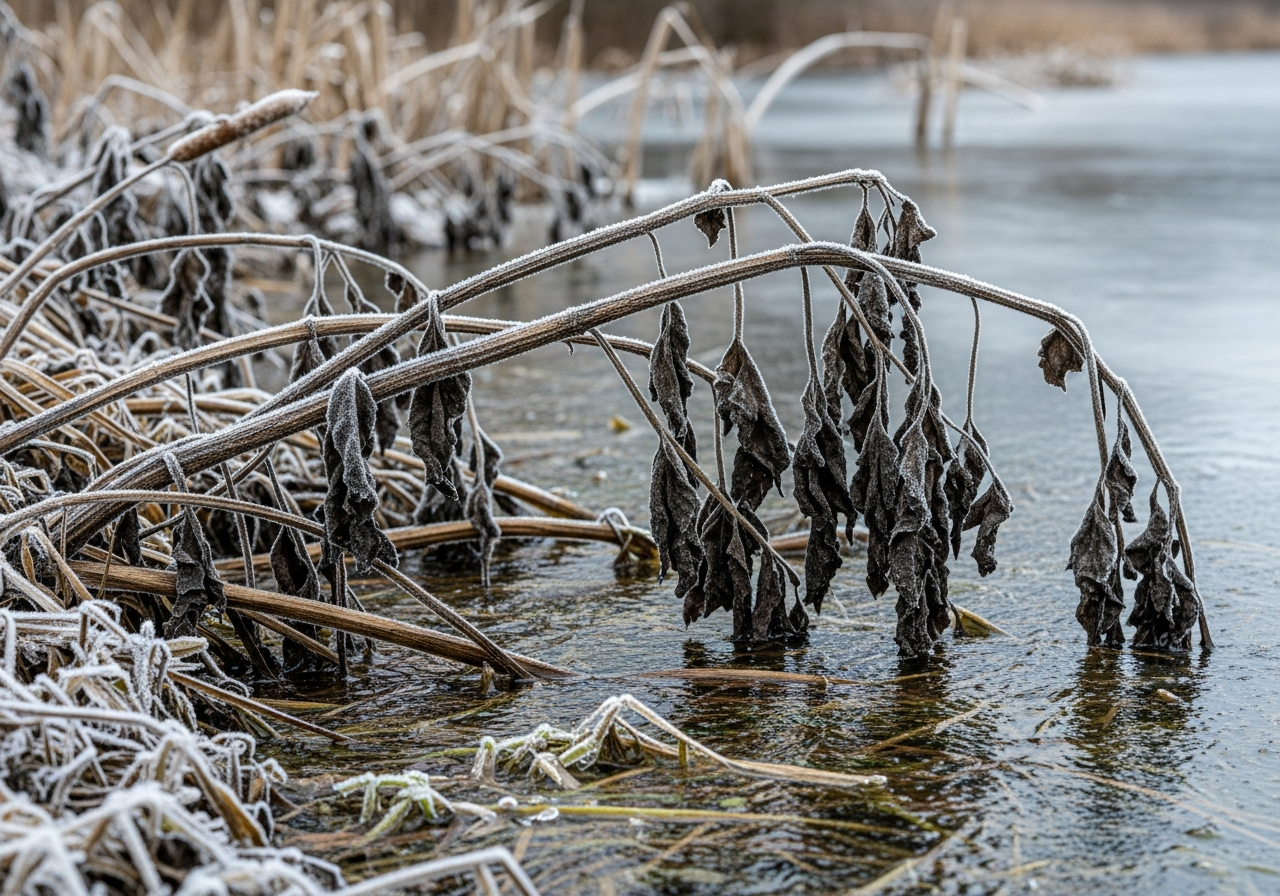
The most consequential moment in any Ludwigia peploides invasion is the window between initial establishment and the formation of a closed mat — typically the first 1–3 growing seasons in a new location. During this window, the infestation is small, discrete, and vastly more responsive to management intervention than a mature infestation. This article focuses on the techniques that enable detection in this critical early window. For the complete visual identification guide at all life stages, see Visual Identification Guide to Ludwigia peploides.
The Value of Early Detection
The economic case for early detection is compelling. Research consistently shows that the cost of managing Ludwigia peploides infestations increases exponentially with infestation size — because biomass removal requirements increase, herbicide coverage areas expand, and the probability of fragment dispersal (and therefore reinfestation) rises with mat density and extent. A single plant or a 1 m² cluster can be removed entirely with hand tools in minutes. A 100 m² mat requires professional herbicide application or mechanical harvesting. A hectare-scale infestation requires a multi-year management program costing tens of thousands of dollars annually. The economic cost of inaction — letting a small infestation grow to full mat stage — consistently exceeds the cost of early treatment by 10× or more.
Seedling Recognition
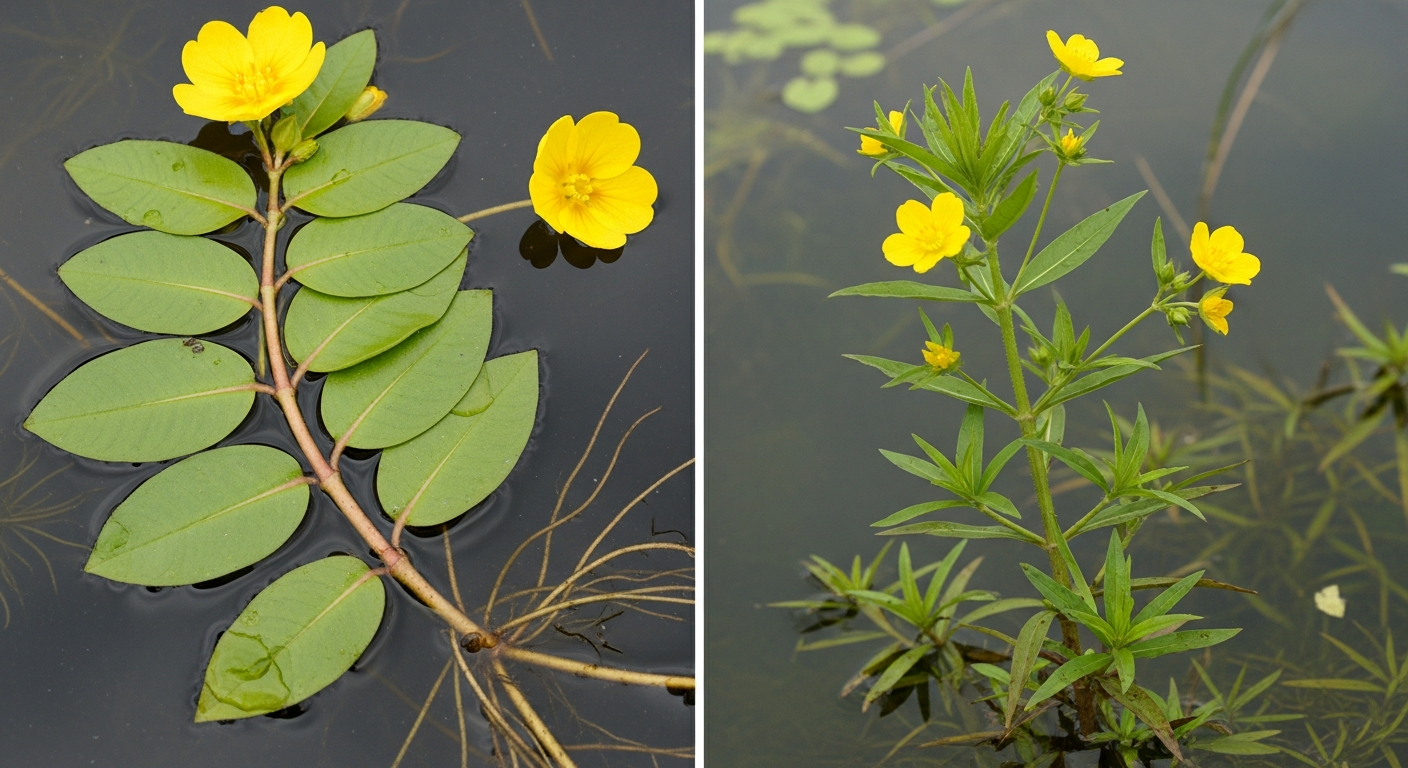
The seedling stage of L. peploides is the most difficult to identify but also the stage at which intervention is cheapest and most complete. Seedlings emerge from wet sediment in spring when soil temperatures exceed 15°C. The first pair of leaves (cotyledons) are rounded and 2–4 mm long. The first true leaves — already showing the characteristic alternate arrangement, shiny surface, and oblong outline — appear within 1–2 weeks. At 5–10 cm height, young plants can be identified with reasonable confidence by examining leaf arrangement (alternate), leaf surface (shiny), and stem character (green, often reddish at the nodes). No pneumatophores are yet visible at this stage. Systematic ground-level surveys of wet margins in spring — conducted by trained observers wearing appropriate footwear — are the primary means of detecting seedling-stage plants.
Isolated Stem Identification
After the seedling stage but before mat formation, individual stems 20–60 cm in length float or creep across the water surface, rooting at nodes. At this stage, all diagnostic vegetative features are present: alternate shiny leaves, nodal rooting, pneumatophores at submerged nodes, and the characteristic creeping/floating habit. Identification is straightforward if the observer is familiar with the diagnostic features. The challenge is locating isolated stems in large water bodies where they may be scattered widely. Kayak or canoe surveys, slowly paddling along shorelines and checking all emergent and floating vegetation, are effective for detecting isolated stems in water bodies up to a few tens of hectares. For larger water bodies, drone surveys are more efficient.
Environmental DNA (eDNA) Sampling
Environmental DNA technology represents a transformative advance in early detection capability. L. peploides sheds DNA continuously into the surrounding water through root exudates, pollen, and decaying tissue. Validated eDNA assays (PCR-based tests using species-specific primers) can detect this DNA in filtered water samples with extraordinary sensitivity — potentially identifying the species' presence from a single plant per hectare of water body, weeks before any above-ground growth would be visible to field surveyors. Water samples are collected in 1–2 liter volumes, filtered through 0.45 µm membranes in the field, and sent to a laboratory for DNA extraction and PCR analysis. Results are typically available within 1–2 weeks. Commercial eDNA testing services for aquatic invasive plants are available from several specialist laboratories.
eDNA sampling is particularly effective for: monitoring high-risk entry points (water body inflows, boat launch sites, water garden outfalls) where regular sampling can detect introductions before establishment; post-management monitoring to confirm eradication without exhaustive field surveys; and winter monitoring when above-ground plants are dormant.
Remote Sensing and Drone Surveys
Unmanned aerial vehicles (drones) equipped with RGB or multispectral cameras enable efficient mapping of aquatic vegetation over large areas. L. peploides mats can be distinguished from surrounding native vegetation using their characteristic spectral reflectance signature — particularly in the near-infrared spectrum, where the dense floating mat produces a distinctive signal. Machine learning classifiers trained on labeled L. peploides imagery have achieved mapping accuracies above 90% in published studies. Drone surveys are most effective for mats larger than approximately 5–10 m² — below this threshold, the spatial resolution of typical drone sensors is insufficient for reliable automated detection, though manual image inspection can detect smaller patches. Satellite imagery (Sentinel-2, PlanetScope) provides lower spatial resolution but enables cost-effective coverage of very large areas for watershed-level monitoring.
Rapid Response After Detection
Early detection only delivers its management cost advantages if it is followed by rapid response — ideally within the same growing season as detection. The standard rapid response protocol includes: (1) confirmation of species identity by a qualified botanist or through eDNA analysis; (2) mapping of the full infestation extent using systematic field survey; (3) treatment authorization and permit acquisition (herbicide treatments typically require aquatic use permits); (4) treatment within the same growing season if feasible; and (5) monitoring the following season to detect regrowth. Many states have rapid response programs that can mobilize treatment resources within days to weeks of a confirmed new detection. Report confirmed new occurrences through official channels to trigger these programs. See our Early Detection management guide for program design and rapid response protocols.
Conclusion
Early detection of Ludwigia peploides before mat formation dramatically reduces management costs and improves the probability of achieving eradication or long-term suppression. Combining systematic spring ground surveys, eDNA water monitoring at high-risk sites, and drone aerial mapping in summer creates a multi-layered detection system sensitive to infestations at every stage from single plants to developing mats. The technology and protocols for early detection are well established — the limiting factor in most regions is the systematic application of these methods across all high-risk water bodies, which requires sustained investment in monitoring programs.