Ludwigia peploides Distribution in California
The invasion history, current distribution, management programs, and outlook for Ludwigia peploides in California — home to one of the world's largest and most ecologically significant aquatic plant invasions.
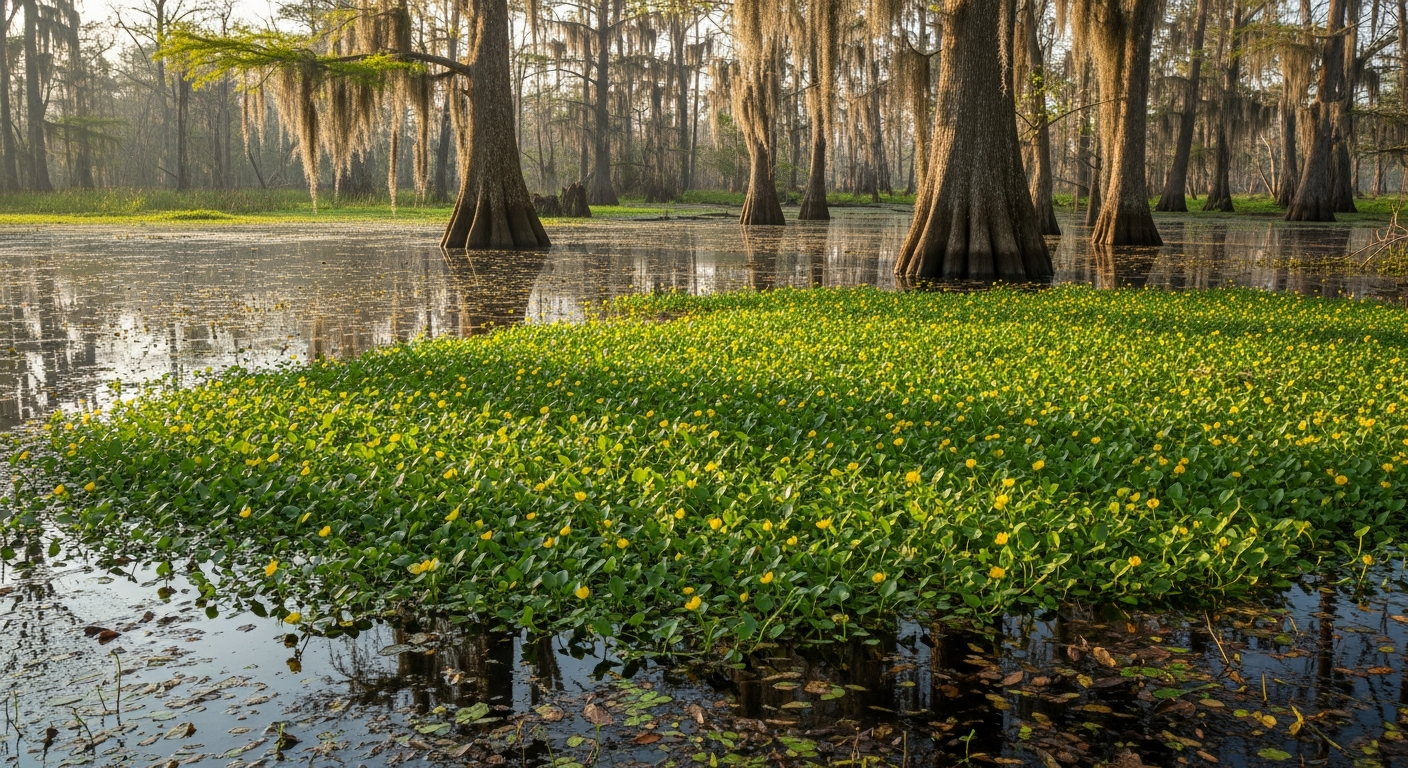
California's experience with Ludwigia peploides represents one of the most significant aquatic invasive plant management challenges in the United States. With established populations across much of the state — from the cool channels of the Sacramento-San Joaquin Delta to the warmer waters of Southern California — the species has fundamentally altered California's freshwater ecosystems and created ongoing economic burdens for water managers, landowners, and recreation users. This article examines the California distribution in detail, from the history of invasion to the current management programs. For the broader US context, see our US Distribution article.
Invasion History in California
The earliest documented California record of L. peploides is a herbarium specimen collected near Sacramento in 1945. Whether this represents a very early introduction or a population that had been present and undetected for years is unclear, but the Sacramento-San Joaquin Delta was almost certainly the initial epicenter of the California invasion. The species likely arrived via the water garden or aquarium trade — it was widely sold as an ornamental aquatic plant through the mid-20th century and may have been planted in private ponds or garden water features from which it escaped into waterways.
Through the 1950s, 60s, and 70s, the California infestation expanded gradually. By the 1980s and 90s, management agencies began documenting the scale of the problem in the Delta, and the first organized management programs were initiated. The combination of the Delta's ideal invasion conditions — warm summer temperatures, slow-moving nutrient-rich water, frequent hydrological disturbance — and the near-impossibility of preventing reinfestation from the enormous standing seed bank has made the California infestation one of the most persistent in the world.
The Sacramento-San Joaquin Delta
The Sacramento-San Joaquin Delta — a 1,100-square-mile network of waterways, islands, and tidal marshes at the confluence of the Sacramento and San Joaquin Rivers — is the epicenter of California's Ludwigia peploides problem. The Delta's approximately 700 miles of channels provide extensive colonizable habitat, and its warm summer temperatures (regularly exceeding 25°C) promote rapid growth. Nutrient enrichment from agricultural runoff and urban discharge provides optimal growing conditions. By the early 2000s, surveys were documenting Ludwigia as one of the three most abundant invasive aquatic plants in the Delta, alongside Brazilian waterweed (Egeria densa) and water hyacinth (Eichhornia crassipes). For a deep dive into the Delta invasion, see our Sacramento Delta invasion article.
Distribution Outside the Delta
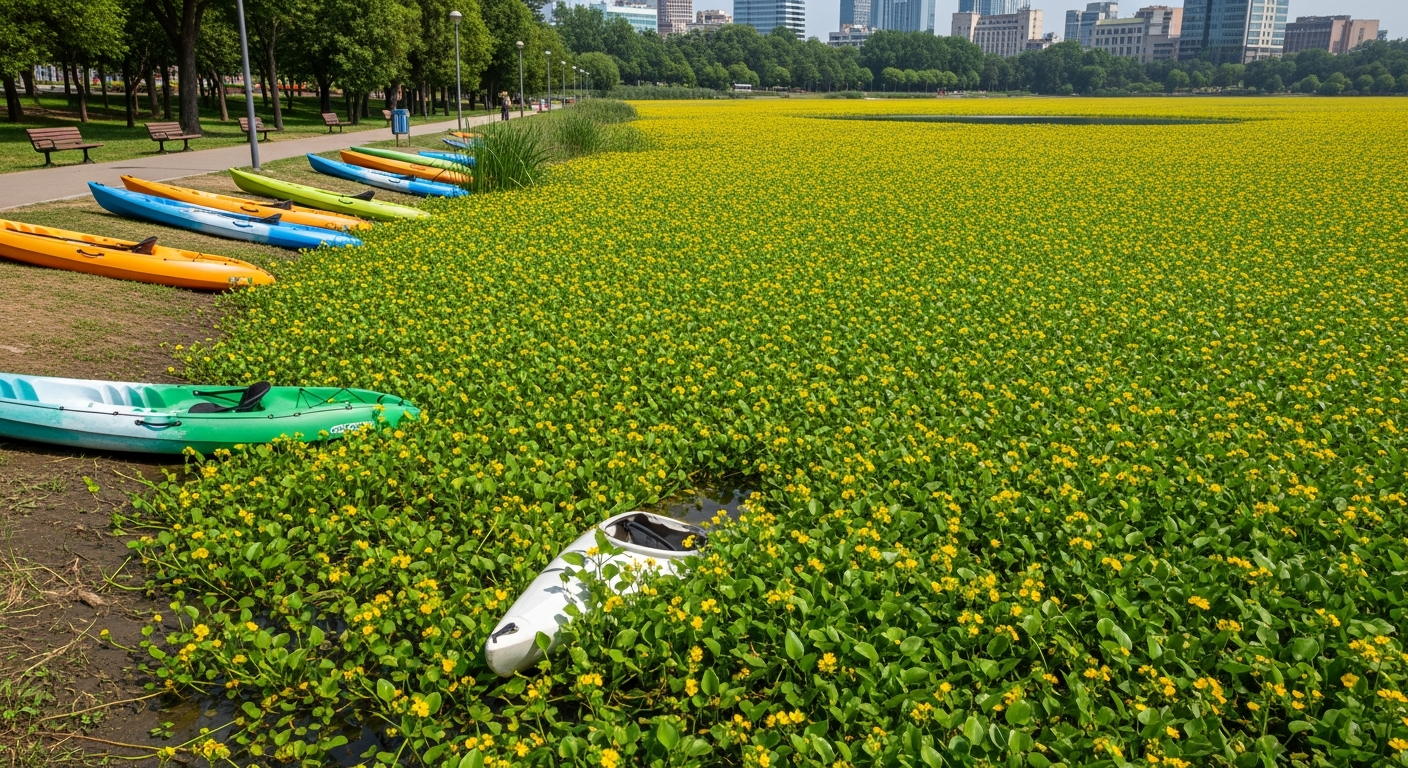
Ludwigia peploides is documented in numerous California counties beyond the Delta. In the Central Valley, it occurs in irrigation channels, agricultural drainage canals, and the slower reaches of the San Joaquin River and its tributaries. Populations have been documented in Fresno, Tulare, Kern, and Merced counties. In coastal Northern California, it occurs in rivers flowing to the Pacific, including portions of the Russian River and Napa River systems. In Southern California, populations are established in the Los Angeles River system, Orange County waterways (Santa Ana River and tributaries), and the San Diego River. Coastal wetlands from Santa Barbara to San Diego have documented occurrences. The species is absent from high-elevation mountain habitats (above approximately 1,000 m) where water temperatures are too cool for establishment.
California's Management Response
California has invested heavily in Ludwigia peploides management, with the Delta program representing the largest single investment. The California Department of Fish and Wildlife (CDFW) leads aquatic invasive plant management in the Delta under the Aquatic Invasive Plant Management Program, working in coordination with the Department of Water Resources (DWR) and the US Army Corps of Engineers. The program employs a combination of herbicide treatment (primarily imazapyr and triclopyr with aquatic-approved formulations), mechanical harvesting in areas where herbicide use is restricted, and an annual post-treatment monitoring program. The scale of the program — involving aerial and boat-based herbicide applications over thousands of acres — makes it one of the most complex aquatic plant management operations in North America.
The California Department of Food and Agriculture (CDFA) lists L. peploides as a Class A Noxious Weed, requiring mandatory management on all property where it is found. The California Invasive Plant Council (Cal-IPC) rates it as a High Invasiveness species. For information on management costs in California, see our Lake vs Pond Removal Costs article.
Outlook
The outlook for Ludwigia peploides in California under climate change is concerning. Projected warming of California's water temperatures will extend the growing season and expand the thermal envelope suitable for invasion northward and to higher elevations. Drought periods followed by flood events — both projected to increase in frequency under climate change — create ideal conditions for Ludwigia expansion: drought reduces competition from other aquatic plants, while floods facilitate fragment and seed dispersal throughout river systems. Without sustained management investment, current infestations will expand, and new areas will become invaded. The climate change interaction article provides a detailed analysis of projected range expansion.
Conclusion
California's Ludwigia peploides invasion — centered on the Sacramento-San Joaquin Delta but now extending to waterways across the state — represents one of the most ecologically and economically significant aquatic plant management challenges on the West Coast. Decades of management investment have achieved significant biomass reduction in treated areas, but eradication from the Delta system is not achievable with current technology. The management goal has shifted from eradication to suppression — reducing biomass to levels where ecological and economic impacts are minimized. This requires sustained annual investment in treatment and monitoring, a commitment that must be maintained indefinitely as long as the species persists in the California landscape.