Identifying Ludwigia peploides by Its Flowers
A detailed examination of the diagnostic floral features of Ludwigia peploides — petal morphology, sepal characters, stamen arrangement, pollination biology, and fruit development — for definitive species confirmation.
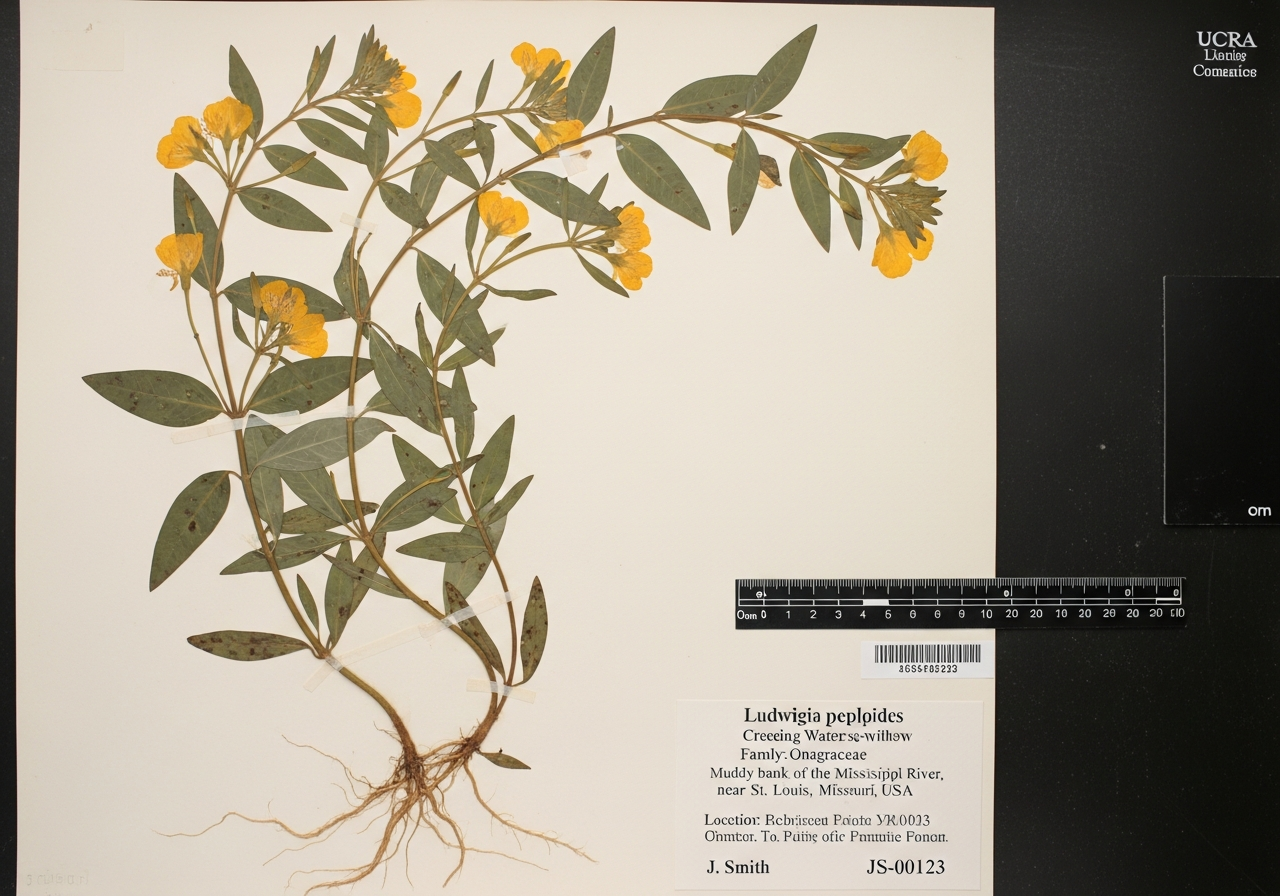
The flowers of Ludwigia peploides are both its most visually striking feature and its most reliable identification character. While vegetative features (leaf arrangement, pneumatophores, growth habit) allow confident identification for much of the year, the flowers — when present — provide definitive confirmation at a glance. This article examines the floral anatomy in detail, with notes on its diagnostic value for species-level identification. For the complete field guide covering all growth stages, see How to Identify Creeping Water Primrose.
Floral Formula
In botanical notation, the floral formula of L. peploides is: ⊕ K5 C5 A10 G(5̄), meaning: actinomorphic (radially symmetrical), 5 sepals (calyx), 5 petals (corolla), 10 stamens (andröcium), and a 5-carpellate inferior ovary (gynoecium). The inferior ovary position — below the calyx — is characteristic of the family Onagraceae and of genus Ludwigia, and is visible in the field as the swollen "hip" below the open flower. This floral plan distinguishes Ludwigia flowers from superficially similar yellow flowers in other families where the ovary is superior.
Petals and Sepals
The five petals are the most immediately striking feature. Each petal is broadly obovate to fan-shaped, 1.5–2.5 cm long and 1.2–2.0 cm wide, with a slightly notched or wavy apex. The color is bright golden-yellow (Munsell approximately 7.5Y 8/12), consistent and vivid — not pale or cream-colored. Petals are not fused and separate cleanly from the receptacle as they fall, typically on the second or third day after opening. The five sepals are green, lance-shaped, 1.2–2.0 cm long, approximately equal in length to the petals, and remain on the developing fruit after the petals fall. The persistence of sepals on the developing capsule is a useful identification character when flowers are partly developed or if petals have already fallen.
Stamens, Style, and Ovary
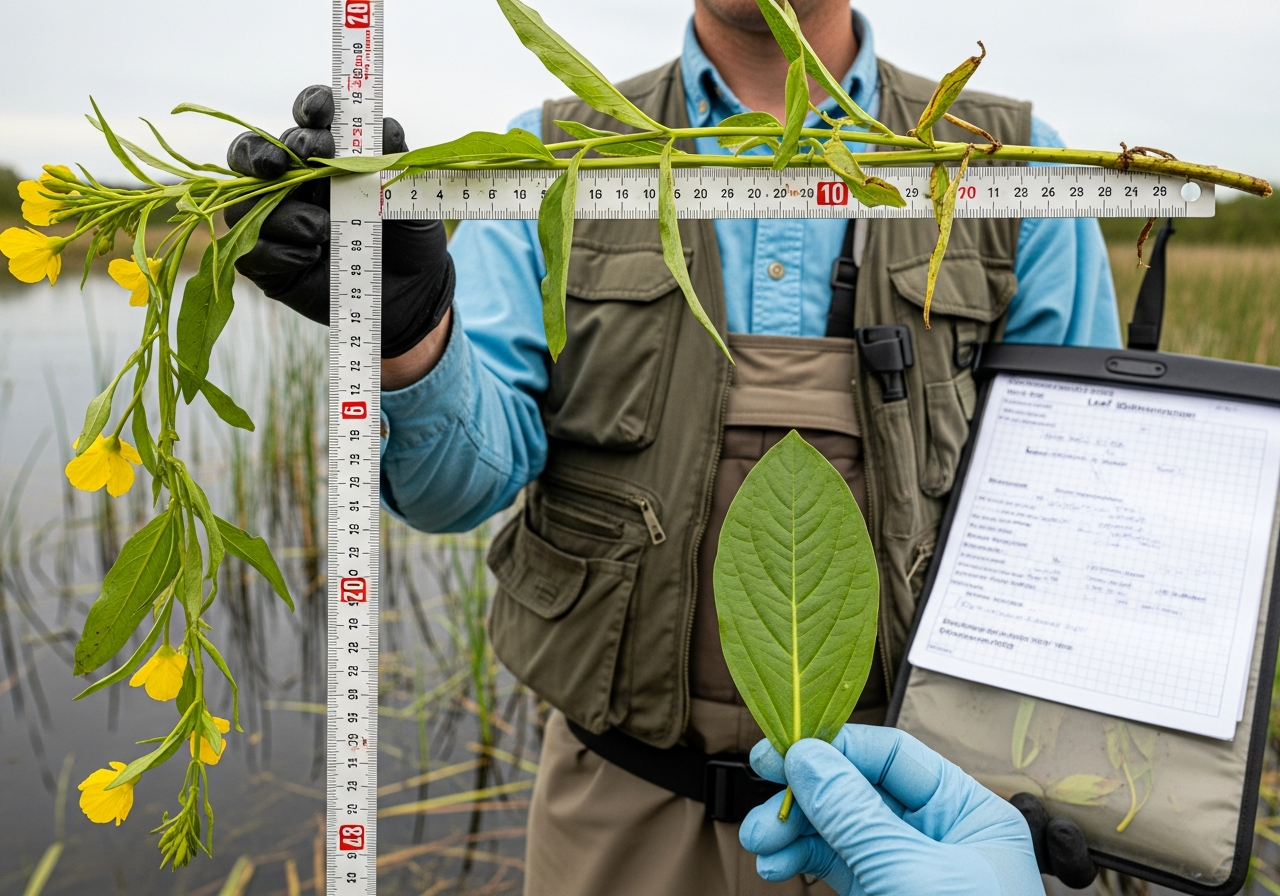
Ten stamens are arranged in two whorls of five. The outer whorl, alternating with the petals (epipetalous position), tends to be slightly shorter than the inner whorl, alternating with the sepals. All stamens have yellow anthers producing abundant yellow pollen. The style is single, 4–8 mm long, with a capitate (rounded, head-like) stigma that is 4–5 lobed. The inferior ovary is fusiform (spindle-shaped) and becomes the elongated fruit capsule after fertilization. The ovary wall is 5-carpellate with numerous ovules in each locule, providing the capacity for abundant seed production from each flower.
Pollination Biology
The flowers of L. peploides offer both pollen and nectar as rewards to pollinators. The primary pollinators are bumblebees (Bombus spp.), which are attracted visually by the bright yellow petals (and by UV patterns on the petals invisible to humans but highly conspicuous to bees) and by floral scent. Bees alight on the flower and collect pollen from the anthers; in doing so, pollen from previously visited flowers is deposited on the stigma. The position of flowers well above the water surface — on upright emergent shoot tips — ensures accessibility to terrestrial bee pollinators even where mats are dense. Cross-pollination between plants is common, ensuring genetic diversity in sexually produced offspring. In dense, widespread infestations, the abundance of flowers and associated pollinator activity is both ecologically significant (as a resource for bees) and a management concern (as a source of seed dispersal).
Fruit and Seed Development
Following pollination, the ovary wall expands to form a cylindrical capsule 1–3 cm long and 3–5 mm in diameter. The fruit is green initially, turning brown at maturity. It has five slightly raised ridges corresponding to the five carpels and bears the persistent sepals at its tip. The capsule dehisces irregularly — opening along irregular cracks in the wall rather than along defined suture lines — releasing 20–40 seeds per capsule. Seeds are minute (0.5–0.8 mm long), brown, with a hard seed coat that resists desiccation and enables prolonged viability in the sediment seed bank. Seeds are buoyant and can disperse via water currents; they also survive passage through the digestive systems of waterfowl, enabling long-distance endozoochoric dispersal. The ecological significance of seed production and dispersal is explored further in Ludwigia peploides Reproduction Explained.
Flowering Phenology
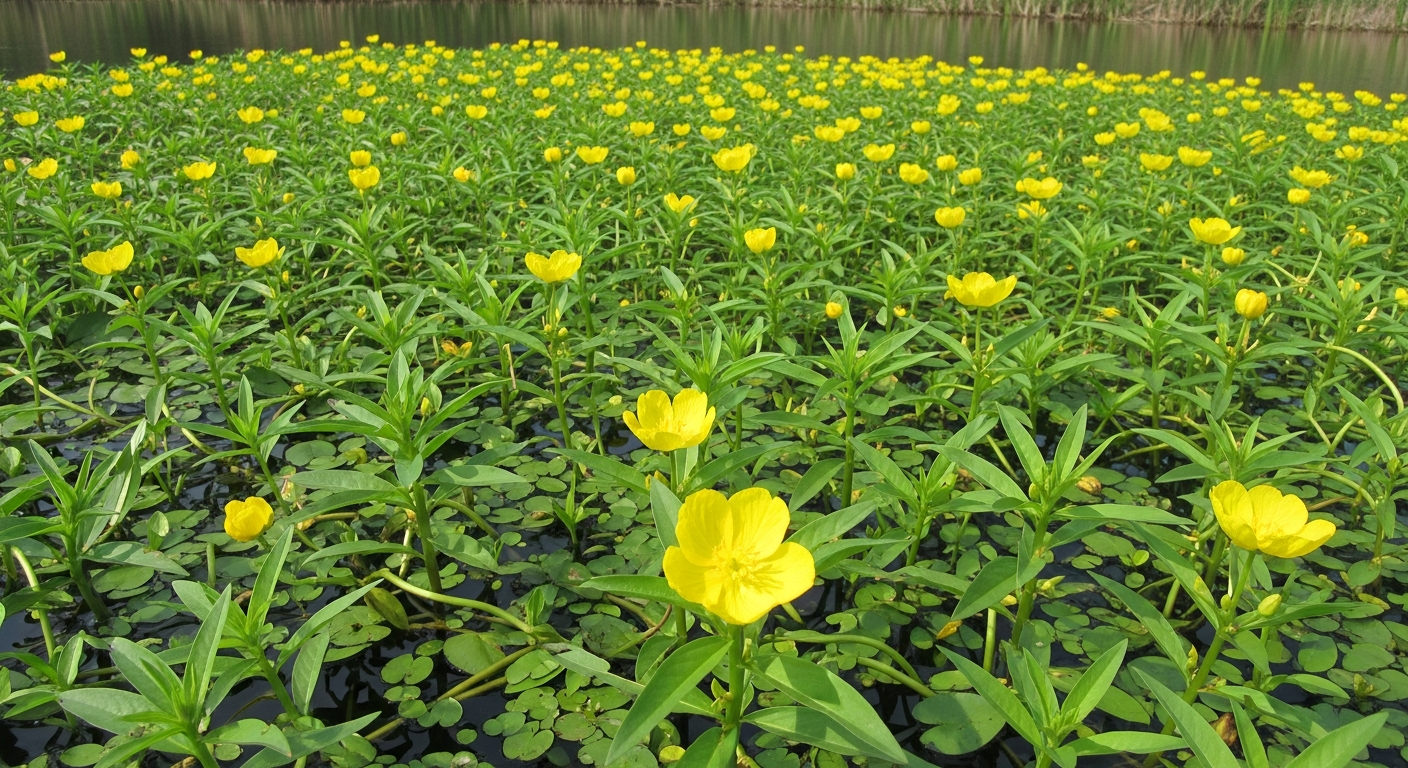
In temperate North America (e.g., California, the southeastern US), flowering begins in late April or May and continues through October in warm years. Peak production is in June–August when temperatures are highest and stem growth is most vigorous. Individual flowers open in the morning and last 1–3 days. A large established plant may produce hundreds of flowers over the course of a season and thousands of seeds. In tropical and subtropical climates, flowering is less strictly seasonal and may continue year-round at reduced intensity. The phenology of flowering has management implications: treatment before peak seed production reduces dispersal of new propagules, while treatment after capsule development must account for the possibility that seeds may already have been released.
Conclusion
The flowers of Ludwigia peploides are among the most reliable and easily observed identification features for the species. The combination of 5 large bright yellow petals (4–6 cm flower diameter), 5 persistent green sepals, and 10 stamens in two whorls is diagnostic for L. peploides — distinguishing it from the 6-petaled L. hexapetala, the smaller-flowered native species, and all other common confusion taxa. When surveying for Ludwigia peploides, timing surveys to coincide with the flowering period (May–September in temperate regions) significantly increases detection probability and enables definitive identification without specialist botanical training.