Mechanical Harvesting Methods for Ludwigia peploides
Equipment types, operational protocols, fragment containment systems, and disposal requirements for effective mechanical removal of Ludwigia peploides from aquatic systems.
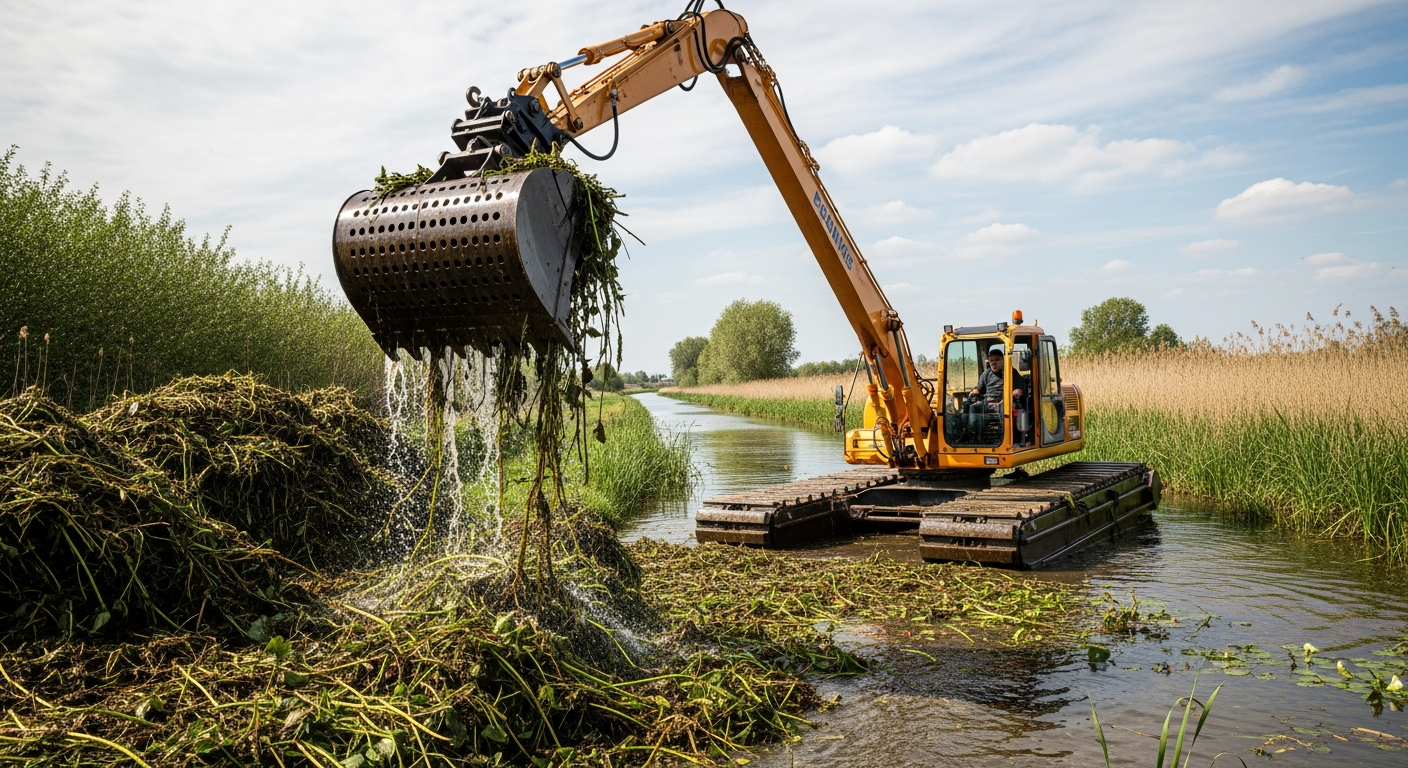
Mechanical harvesting of Ludwigia peploides is the preferred management method in water bodies where herbicide use is restricted — near drinking water intakes, in swimming areas, or at sites with policy preferences for non-chemical management. It is also used to reduce initial biomass before herbicide treatment in dense infestations. This article covers the major equipment types, operational protocols, and critical fragment containment requirements. For cost information, see Mechanical Removal Costs. For herbicide methods, see Best Herbicides for Ludwigia.
Aquatic Weed Harvesters
Aquatic weed harvesters are specialized, self-propelled boats with a rotating cutting head at the bow that cuts vegetation at an adjustable depth, and a conveyor system that transports cut material to a collection platform at the stern. They range in size from small 2–3 meter wide machines suitable for narrow canals to large 5+ meter wide industrial machines for lake management. Productivity depends on mat density, water depth, debris content, and machine size — typically 0.5–2 acres per 8-hour operating day in moderate-density Ludwigia mats. Harvesters are most effective for reducing surface biomass in accessible water bodies with sufficient water depth (typically at least 60–90 cm). They are not effective at root crown removal — this is their primary limitation for Ludwigia control, as root crowns survive and regenerate even after thorough surface harvesting.
Amphibious Excavators
Amphibious excavators are modified track excavators equipped with pontoon floats that allow operation in shallow water (typically up to 1–2 m depth). They are used for root-level removal — physically excavating the root crown mass from the sediment to the full depth of root penetration (typically 20–50 cm). This is the most thorough form of mechanical removal, addressing the root crowns that harvesters leave behind. However, it is far more expensive ($3,000–$8,000 per day operated) and much slower (0.1–0.5 acres per day) than harvesting, and causes significant sediment disturbance that must be managed for turbidity and nutrient release. Amphibious excavators are most appropriate for small to medium areas where thorough root removal is required and where the cost is justified by the value of the habitat being protected.
Suction Dredges
Suction dredges use hydraulic pumps to create a water current that lifts plant material and sediment from the water body floor, passing it through screens to capture plant fragments while returning water. They are less commonly used for Ludwigia management than harvesters or excavators because they generate large volumes of turbid water that must be managed, and because the slurry of plant fragments and sediment requires disposal. However, in some configurations — particularly with fine-mesh screening to capture propagules — suction dredges can effectively remove both above-ground biomass and root crowns simultaneously. They are most practical for canal and ditch management where the linear geometry facilitates placement and operation.
Fragment Containment: Critical to Success
Fragment containment is the most important operational protocol for mechanical Ludwigia management and the most commonly neglected. Without effective containment, cutting operations generate thousands of viable propagules — stem internodes, leaf-node pieces, and rhizome fragments — that disperse throughout the water body and downstream, potentially expanding the infestation rather than reducing it. Containment methods include: (1) floating boom barriers — absorbent or solid floating booms deployed perpendicular to current flow downstream of the harvesting operation, intercepting floating fragments; (2) fine mesh screens at water control structures and outflows — 1–5 mm mesh that intercepts fragments while allowing water to pass; (3) harvester collection conveyors — all modern harvesters include conveyors that collect and deposit cut material onto the harvester platform for off-site disposal, preventing fragments from falling back into the water. The minimum containment standard for any mechanical Ludwigia removal operation should include boom barriers downstream and fine mesh screens at all water body outflows.
Disposal Protocols
Collected Ludwigia biomass must be disposed of in a manner that prevents re-establishment. The standard protocol is: (1) transport from the water body on the harvester collection platform; (2) offload to a transport vehicle at an upland staging area at least 50 m from the water body edge; (3) transport to a commercial composting facility, green waste transfer station, or permitted landfill. Material should never be deposited along the water body bank in a location where storm runoff, high water, or animal activity could transport it back to the water body. For small volumes, thorough drying in a contained upland area (at least 3–5 days of full sun in summer) before disposal prevents re-rooting. Check your state's requirements for invasive species material disposal before beginning operations — some states have specific regulatory requirements.
Conclusion
Mechanical harvesting of Ludwigia peploides provides effective surface biomass reduction but requires stringent fragment containment to be management-positive rather than spreading the infestation. For thorough root crown removal, amphibious excavators provide the most complete mechanical control but at significantly higher cost and effort. Mechanical methods are most valuable in chemically restricted sites or as a biomass reduction step before herbicide treatment in dense infestations. See our Integrated Management guide for how mechanical methods fit into a complete management program.