Subspecies and Varieties of Ludwigia peploides
The five recognized subspecies of Ludwigia peploides — their morphological distinctions, native range, invasive status, and significance for identification and management programs.
The taxonomy of Ludwigia peploides has been subject to considerable revision over the past century. What is now treated as a single polymorphic species with five subspecies was previously divided into several separate species. Understanding subspecific variation matters for regulatory purposes (some regulations list specific taxa by name) and for interpreting research literature that may reference older taxonomic treatments. For basic identification information, see How to Identify Creeping Water Primrose.
Subspecies peploides
The nominate subspecies, L. peploides subsp. peploides, has its center of diversity in southern South America (Argentina, Uruguay, Chile, southern Brazil). It tends to be less hairy than other subspecies, with moderately sized leaves (3–8 cm) and typical 5-petaled flowers 3–5 cm in diameter. Stipules (small leaf-like appendages at the base of the petiole) are small and often deciduous. This subspecies is less widely established as an invasive than subsp. montevidensis, though it does occur outside its native range in some localities.
Subspecies montevidensis
Subspecies montevidensis is the most widely invasive taxon within the L. peploides complex and the form most commonly encountered in North American and Asian invasions. Native to subtropical South America (Brazil, Uruguay, Argentina), it is characterized by slightly larger leaves and flowers, moderate stem hairiness, and persistent stipules. It forms the most aggressive mats under a wide range of environmental conditions and has the broadest thermal tolerance within the complex. Most research on L. peploides invasiveness and management is based on this subspecies.
Subspecies hexapetala / Ludwigia hexapetala
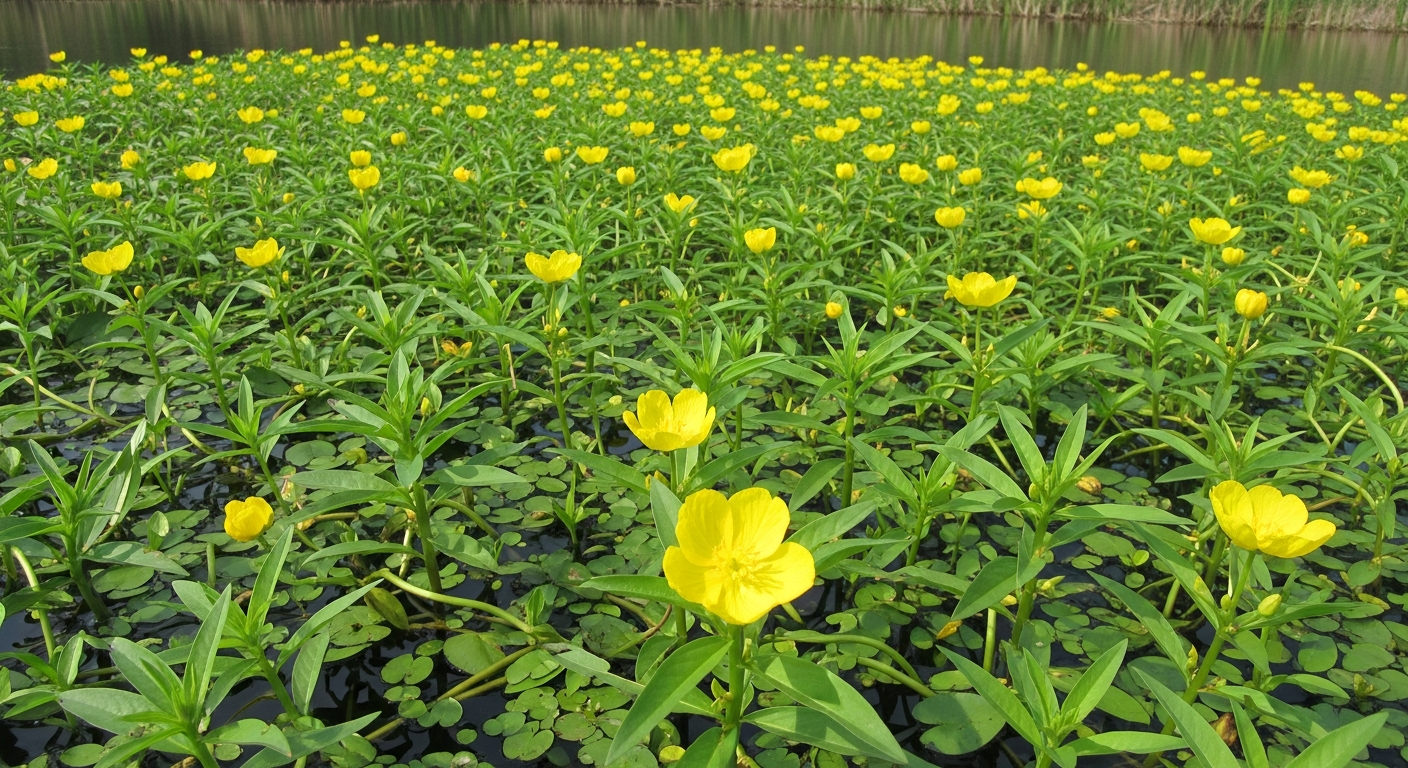
This taxon occupies a debated position in the taxonomy of the group. Recognized as L. peploides subsp. hexapetala by some authorities and as the distinct species Ludwigia hexapetala by others, it is distinguished by having 6 petals and 12 stamens rather than the typical 5 + 10. It is prominently invasive in France (where it co-occurs with L. peploides s.s.), Portugal, Spain, Italy, and some US localities. EU regulation 1143/2014 lists both Ludwigia peploides and Ludwigia hexapetala (syn. L. uruguayensis) separately as Invasive Alien Species of Union Concern. Field identification of this taxon is possible by carefully counting petals — 6 instead of 5 — on fresh flowers.
Subspecies stipulacea
Subspecies stipulacea is distinguished by its large, conspicuous, and persistent stipules — often 5–15 mm long, forming a distinctive fringe around the node. It is native to a narrower range in central South America and is less frequently encountered in invasive contexts than subsp. montevidensis or hexapetala. Where it does occur outside its native range, it behaves similarly to other invasive subspecies. The large stipules are the most reliable distinguishing character for this form in the field.
Subspecies glabrescens
Subspecies glabrescens — meaning "becoming smooth or hairless" — is characterized by nearly or completely glabrous (hairless) stems and leaves. It is native to the warmer lowland regions of central and northern South America and Central America. Its reduced hairiness distinguishes it from the typically hairy subsp. montevidensis but requires careful comparison. It is the least frequently encountered subspecies in invasive contexts, though its invasive potential under warming climates is under active assessment.
Subspecies and Management Implications
From a practical management perspective, subspecific identity rarely affects treatment decisions. All invasive taxa in the L. peploides complex respond similarly to herbicide treatment with imazapyr, glyphosate, and triclopyr, and to mechanical removal. The ecological impacts of different subspecies are broadly similar in invaded habitats. However, subspecific identity can matter in regulatory contexts — some jurisdictions list specific taxa separately, and accurate reporting of which taxon is present is important for tracking range expansion and evaluating management program outcomes. See our Best Herbicides guide and Regulatory Frameworks article for treatment and legal context.
Conclusion
The five subspecies of Ludwigia peploides — peploides, montevidensis, hexapetala, stipulacea, and glabrescens — represent a complex of closely related forms spanning the full thermal range of tropical and temperate South America. Their invasion biology is broadly similar, with subsp. montevidensis and the hexapetala taxon being most widely problematic globally. For identification at the species level rather than subspecies, the standard morphological guide to identifying creeping water primrose is sufficient for most field and management purposes. For detailed subspecies-level identification, consult regional flora treatments or submit specimens to a regional herbarium.