Ludwigia peploides Invasion in Europe
How Ludwigia peploides arrived in Europe in the 1820s, spread to become a major freshwater invasive across France, Spain, Portugal, and Italy, and prompted one of the EU's most significant invasive species regulatory actions.
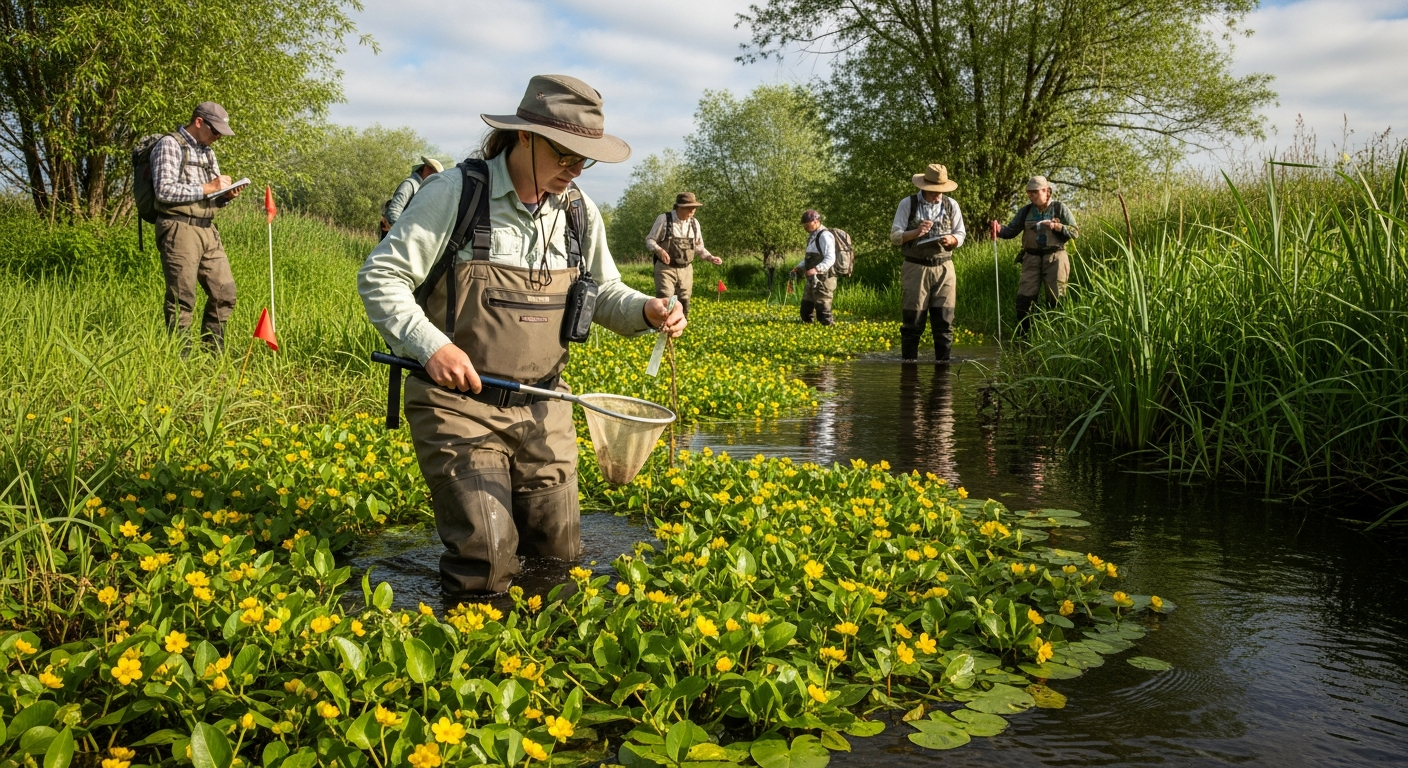
Europe's experience with Ludwigia peploides — and the closely related L. hexapetala and L. grandiflora — provides one of the most thoroughly studied examples of aquatic plant invasion globally. With nearly 200 years of invasion history in France alone, European scientists have contributed fundamental insights into the long-term dynamics of aquatic plant invasions and the challenges of management in complex river and wetland systems. This article examines the European distribution in detail. For a global perspective, see Where Is Ludwigia peploides Found?
France: Epicenter of the European Invasion
France has the longest invasion history and the most extensive infestations in Europe. The first records date to the 1820s in Atlantic-facing river basins of western France, where the mild climate and extensive waterway networks provided ideal conditions for establishment. By the late 20th century, Ludwigia was documented throughout the major Atlantic river systems — Loire, Charente, Gironde, Garonne — and in Mediterranean river systems including the Hérault and tributaries of the Rhône. The Marais Poitevin, a UNESCO-recognized wetland of international importance in western France, became one of the most severely impacted sites in Europe, with tens of thousands of hectares affected and a major management program initiated in the 2000s involving government-funded mechanical and chemical treatment campaigns costing millions of euros annually.
French researchers have generated much of the world's fundamental science on Ludwigia invasion ecology, management efficacy, and ecological impact, providing the evidence base for regulatory action at the EU level. France's long-term management data demonstrates the critical importance of sustained multi-year programs — populations can recover rapidly in any year that treatment is suspended.

Spain and Portugal
The Iberian Peninsula has significant Ludwigia infestations along Atlantic-facing river systems. In Spain, the species is established in river systems of Galicia, Asturias, and the Basque Country, and is spreading southward into Castile and León. Major infestations occur in the Miño, Tambre, and Ulla river basins. Portugal has populations in the Minho and Douro rivers and their tributaries. Both Spain and Portugal have enacted national invasive species regulations that include Ludwigia species and are implementing management programs in coordination with EU requirements. The warmer Mediterranean climates of both countries — particularly in the south — create conditions highly favorable to the species, and further southward expansion within the Iberian Peninsula is expected.
Italy and the Mediterranean
Italy has documented Ludwigia peploides and related species in the Po Valley — a heavily modified agricultural landscape with extensive irrigation infrastructure that provides abundant colonizable habitat. Po Valley populations are of particular concern because of the sheer scale of the agricultural water network (tens of thousands of kilometers of irrigation canals and drainage channels) that could facilitate rapid spread. Mediterranean coastal wetlands in southern France, northeastern Spain (the Ebro Delta), and Italy also have documented invasions. The warm Mediterranean climate is expected to become increasingly suitable as temperatures rise, and the invasion risk to the many Natura 2000 and Ramsar-listed wetlands around the Mediterranean is considered very high.
Germany and Northern Europe
Germany, Belgium, and the Netherlands have documented emerging populations, primarily in Rhine tributaries and associated wetland systems. These northern European populations are at the expanding front of the invasion and are considered the most tractable management targets — populations are still relatively small and discrete, making eradication more achievable than in the extensively infested waterways of France and Iberia. Germany has listed the species under national invasive species regulations and is implementing mandatory management measures as required by EU Regulation 1143/2014. The UK, Switzerland, and Austria have also recorded isolated occurrences that are being actively managed before they can expand.
The EU Regulatory Response
The EU's regulatory response to the Ludwigia invasion in Europe has been one of the most comprehensive regulatory actions for any aquatic invasive plant. EU Regulation 1143/2014, which came into force in 2016, listed Ludwigia peploides, L. grandiflora, and L. hexapetala (syn. L. uruguayensis) as Invasive Alien Species of Union Concern. This regulation prohibits the import, export, transport, trade, possession, breeding, and intentional release of all three taxa in all 27 EU member states. It also requires member states to take management action against established populations to reduce their extent and impacts. The listing and its implementation have significantly reduced the trade in Ludwigia species through European aquatic plant retailers, though enforcement of trade restrictions remains a challenge. For the legal framework in North America, see Regulatory Frameworks for Ludwigia peploides.
Conclusion
Europe's nearly 200-year history with Ludwigia peploides provides both a sobering illustration of what an unmanaged aquatic plant invasion can become — the scale and intractability of the French invasion — and a hopeful example of what strong regulatory action can achieve in containing spread through trade restriction. The EU regulatory framework, combined with national management programs, represents the most comprehensive institutional response to a freshwater invasive plant invasion in the world. The lessons of the European invasion — particularly the critical importance of early intervention before infestations become established — inform management and prevention programs globally.