Ludwigia peploides Look-Alikes and Confusion Species
Distinguishing Ludwigia peploides from its closest relatives — L. hexapetala, L. grandiflora, and native Ludwigia species — critical for accurate survey, regulatory reporting, and targeted management.
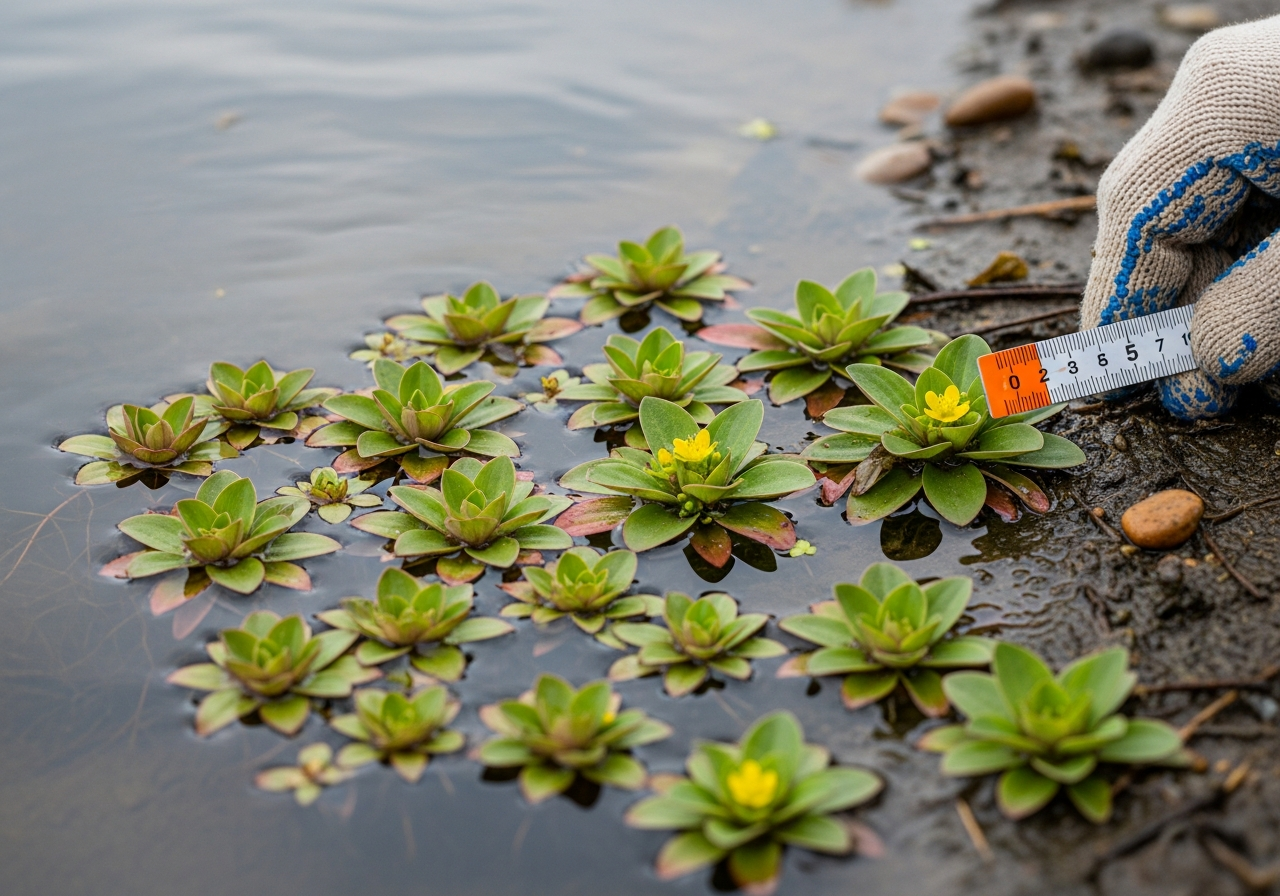
The genus Ludwigia contains over 80 species globally, several of which share the aquatic or semi-aquatic habitat, yellow flowers, and creeping/floating growth form of L. peploides. In invaded regions, two closely related invasive species — L. hexapetala and L. grandiflora — frequently co-occur with L. peploides and require careful separation for accurate regulatory reporting. Native Ludwigia species also occur in many of the same water bodies and must be distinguished from invasive taxa. This guide covers all the key confusion species. For the complete identification protocol, see How to Identify Creeping Water Primrose.
Ludwigia hexapetala (Six-Petaled Water Primrose)
Ludwigia hexapetala (Hooker & Arnott) Zardini, Gu & Raven is the most important confusion species for L. peploides. Sometimes treated as subsp. hexapetala of L. peploides, it is recognized as a distinct species in many current treatments. It is similarly invasive — listed separately in EU Regulation 1143/2014 — and is the dominant invasive Ludwigia in parts of France, Portugal, and Spain. The definitive distinguishing character is petal count: L. hexapetala has 6 petals and 12 stamens per flower, while L. peploides has 5 petals and 10 stamens. This requires careful observation of undamaged flowers but is reliable and consistent. Leaves and growth form are otherwise very similar. In practical management terms, both species are treated identically with the same herbicide protocols and physical methods.
Ludwigia grandiflora (Large-Flowered Water Primrose)
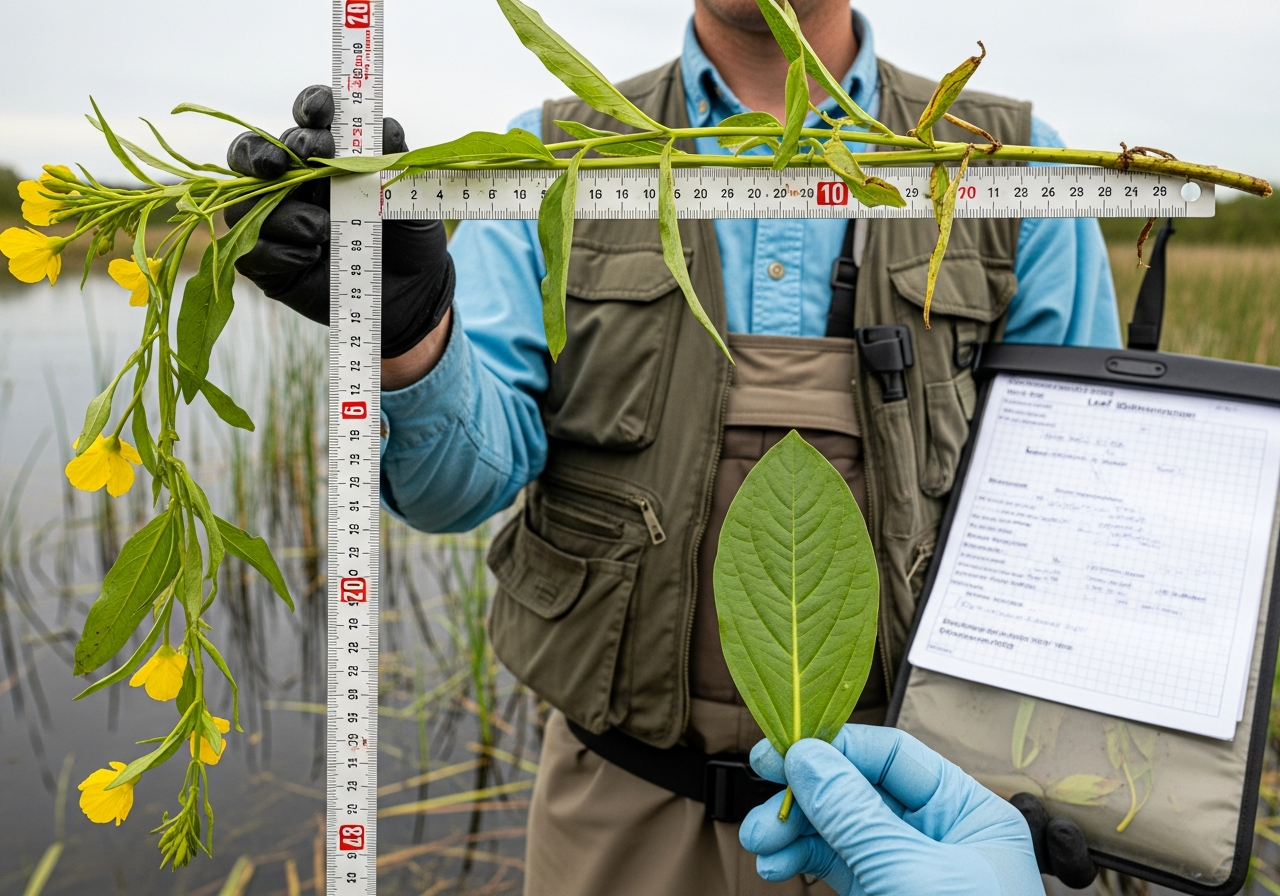
Ludwigia grandiflora (Michaux) Greuter & Burdet is a third invasive water primrose species in the same complex. It is distinguished from L. peploides by its slightly larger flowers (5–7 cm), more prominently veined petals, and more obvious stipules (paired leaf-like structures at the base of each petiole). Native to South America, it has invaded France, Spain, Italy, and some parts of the southern United States. It is listed separately in EU Regulation 1143/2014 alongside L. peploides and L. hexapetala. Management protocols for all three species are essentially identical.
Ludwigia repens (Creeping Primrose-Willow)
Ludwigia repens is a native North American aquatic species popular as an aquarium plant. Escaped populations occasionally establish outdoors. It is immediately distinguishable from L. peploides by its opposite leaf arrangement (leaves in pairs at each node, versus alternately placed in L. peploides). Stems are often reddish. Flowers are small (petals 2–8 mm). No pneumatophores are produced. The opposite leaf arrangement alone rules out L. peploides.
Ludwigia alternifolia (Seedbox)
Ludwigia alternifolia is a native North American species growing in wet meadows, swamps, and wetland margins — sometimes in the same general habitats as L. peploides. It is an erect plant (not floating or creeping) reaching 30–120 cm tall. Leaves are alternate, lance-shaped, and less shiny than L. peploides. Flowers are small with 4 petals (5–10 mm). The fruit is the most distinctive character — a square, box-like capsule (the "seedbox" of the common name). The upright, non-floating growth form and different fruit structure readily separate it from L. peploides.
Other Aquatic Look-Alikes
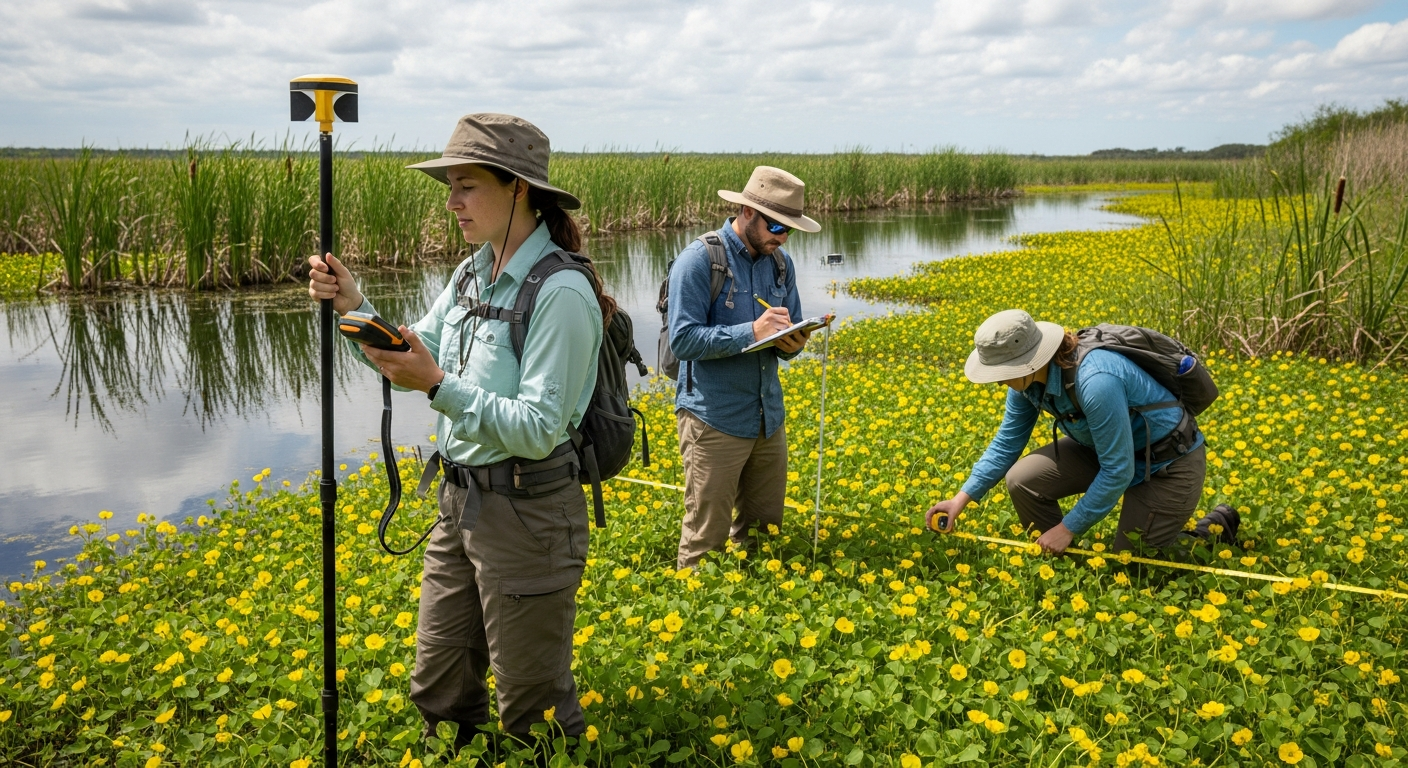
Beyond the genus Ludwigia, a few other aquatic plants occasionally cause identification confusion. Epilobium hirsutum (Great Willowherb) grows in wetland margins, has pink 4-petaled flowers, and belongs to the same family Onagraceae — but pink flowers and distinctly hairy stems immediately distinguish it. Lysimachia nummularia (Creeping Jenny) has yellow flowers and a creeping habit in moist ground, but its flowers are very different in structure (rotate, 5 petals but much smaller, no inferior ovary), and it does not form floating aquatic mats. Ranunculus fluitans (Water Crowfoot) floats in rivers but has white flowers and finely divided submerged leaves. See our comprehensive Ludwigia vs Native Plants guide for additional native species comparisons.
Conclusion
In the field, the most important confusion species for L. peploides are its close invasive relatives L. hexapetala (6 petals) and L. grandiflora (larger flowers) — both similarly invasive and regulated, but requiring separate records for accurate distributional tracking. Native Ludwigia species are distinguished by smaller flowers, opposite leaf arrangements, or different growth forms. Mastering these distinctions enables confident field identification and accurate reporting that underpins effective management at the regional scale.