Understanding Ludwigia peploides Growth Patterns
Seasonal growth dynamics, stem elongation rates, and lateral expansion patterns make L. peploides one of the most rapidly colonizing aquatic plants in invaded temperate water bodies.
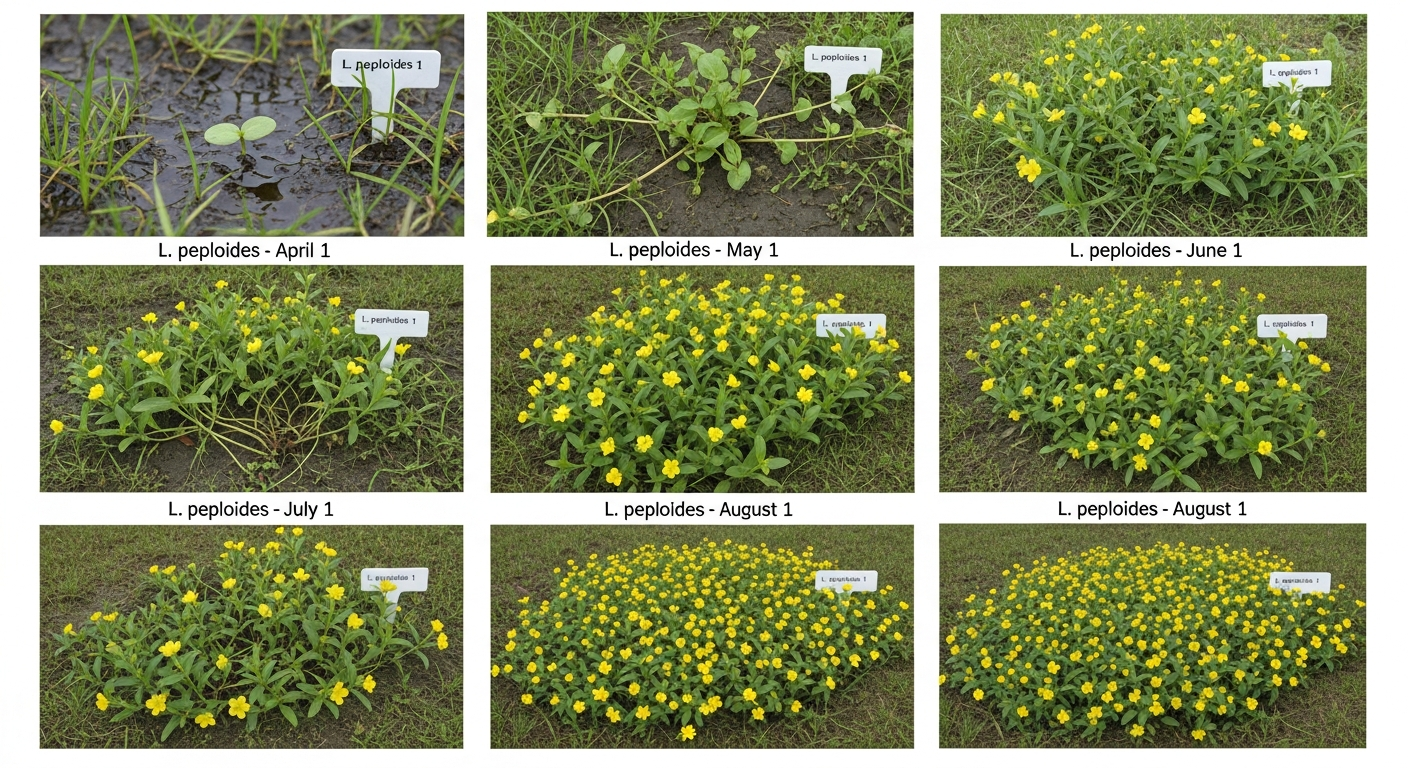
The invasion trajectory of Ludwigia peploides within a single growing season is remarkable. From overwintering rhizomes and stem fragments, the plant progresses through rapid spring emergence, exponential stem elongation during summer, extensive lateral mat formation, and autumn senescence — completing a growth cycle that can transform a clear water body into a dense monoculture within a single season. Understanding these growth dynamics is essential for timing management interventions and predicting colonization spread.
Seasonal Growth Dynamics
Spring regrowth in temperate climates is triggered by increasing water temperatures. Rhizome buds begin to develop new shoots when water temperature consistently exceeds 12°C, typically in March or April at mid-temperate latitudes. Initial growth is relatively slow as the plant draws on carbohydrate reserves stored in overwintering rhizomes. Once shoot photosynthesis reaches sufficient rates to support active growth — typically by late April — the rate of biomass accumulation increases rapidly.
Peak growth rates are achieved during June through August in the Northern Hemisphere, when long daylengths, high solar irradiance, and warm water temperatures are simultaneously optimal. During this period, above-ground biomass can double in as little as one to two weeks under nutrient-enriched conditions. The plateau phase of biomass accumulation occurs in late summer, when self-shading within dense mats and space limitation begin to constrain further growth.
Stem Elongation Rates
Documented stem elongation rates for L. peploides rank among the highest recorded for any temperate macrophyte. Individual stem elongation of 5–10 cm per day has been measured during the peak summer growth phase under controlled mesocosm conditions. Field measurements in European invasion sites have confirmed elongation rates of 3–7 cm per day during July–August. These rates are sustained by highly efficient photosynthate allocation — a large proportion of daily fixed carbon is directed to shoot extension rather than structural thickening, maximizing spatial capture of the water surface.

Lateral Spread and Mat Formation
Lateral spread from an established colony proceeds primarily through stem elongation across the water surface, with adventitious roots developing at each node as the stem contacts the bottom or moist substrate. This clonal expansion strategy is extraordinarily efficient: a single stem can establish multiple new rooted positions along its length, each becoming an independently growing unit that can persist even if the connecting stem is severed.
The rate of lateral mat expansion measured at the colony front ranges from 0.5 to 2 m per week during peak season, depending on water depth, temperature, and nutrient availability. In shallow, warm, nutrient-enriched water bodies, a colony established from a single fragment can expand to cover hundreds of square meters within a single growing season. In deeper or less productive water bodies, expansion rates are slower but still sufficient to overwhelm native vegetation over two to three seasons.
Environmental Modulation of Growth
Temperature, light, and nutrient availability interact to determine realized growth rates in any given environment. Temperature has a direct physiological effect on enzyme kinetics and photosynthetic rates, while light determines the energy available to drive carbon fixation. Nutrients — particularly nitrogen and phosphorus — determine the metabolic capacity to convert fixed carbon into biomass. In eutrophied conditions, the limiting factor for growth shifts from nutrients to light, creating a positive feedback loop where dense mats reduce light penetration, suppressing competing submerged species while L. peploides itself captures light at the surface.
Conclusion
The growth patterns of Ludwigia peploides — rapid spring re-emergence, high-velocity stem elongation, efficient lateral mat expansion, and strategic biomass allocation — collectively produce one of the most aggressive seasonal colonization dynamics observed in temperate aquatic systems. These patterns have direct implications for management timing: interventions are most effective early in the season, before exponential growth phases, and must account for the rapid recovery capacity from residual propagules. Monitoring programs should track colony expansion rates seasonally to identify sites where populations are accelerating and require priority intervention.