Fitness Traits in Ludwigia Populations
Understanding which morphological and physiological traits drive the invasive success of Ludwigia peploides is fundamental to predicting invasion trajectories and developing effective management strategies.
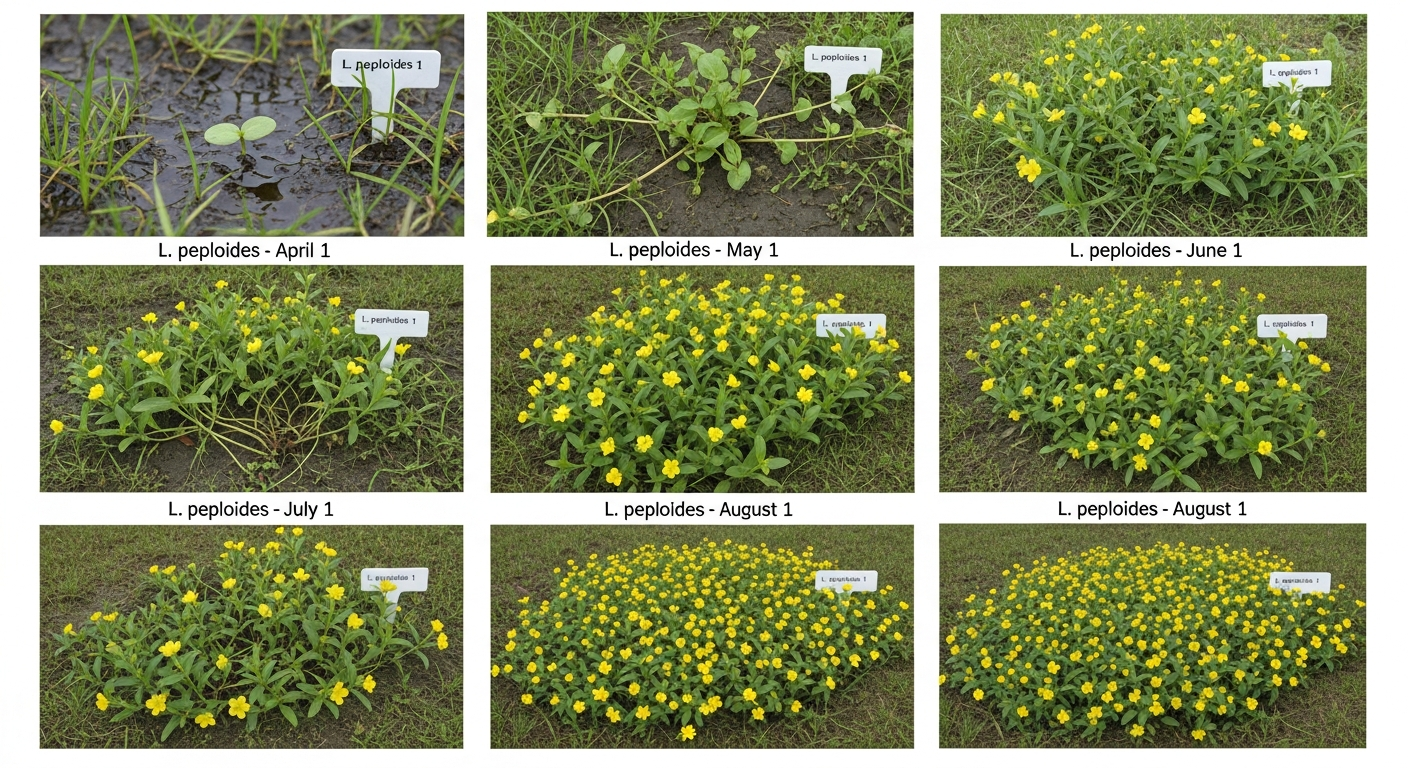
Invasive success in aquatic macrophytes is rarely the product of a single biological advantage. Rather, it emerges from the interaction of multiple traits that collectively enable a plant to establish, persist, and spread across diverse environments. In Ludwigia peploides, a constellation of fitness-related traits — high phenotypic plasticity, efficient clonal propagation, rapid biomass accumulation, and strong competitive suppression of native species — combine to produce one of the most formidable invasive plants in global freshwater systems.
Research programs across Europe, North America, and Australia have systematically characterized these traits across populations spanning a wide geographic range. The emerging picture is of a species not merely tolerant of disturbance and environmental variability, but one whose fitness architecture is specifically suited to exploiting the kind of nutrient-enriched, hydrologically disturbed waterbodies that are increasingly common in human-modified landscapes.
Phenotypic Plasticity in Ludwigia peploides
Morphological Flexibility
Phenotypic plasticity — the capacity of a single genotype to express different phenotypes in response to environmental variation — is perhaps the most important contributor to L. peploides' invasive success. The species displays remarkable morphological flexibility across gradients of water depth, temperature, light availability, and nutrient concentration.
In deep-water environments (greater than 0.5 m), the plant preferentially invests in elongated floating stems that radiate horizontally across the water surface, maximizing access to light while minimizing costly structural investment. In shallow or emergent zones, the same species produces erect, bushy growth with more compact internode spacing and higher leaf area density per unit stem length. This dual morphological strategy allows a single population to simultaneously exploit distinct ecological niches within the same water body.
Physiological Acclimation
Beyond morphology, L. peploides demonstrates significant physiological plasticity in its photosynthetic apparatus. Studies measuring chlorophyll content, photosystem II efficiency (Fv/Fm), and electron transport rates across light gradients show that the species can rapidly acclimate its photosynthetic machinery to both high and low irradiance conditions. This acclimation capacity — particularly the ability to maintain positive carbon balances under moderate shading — enables successful growth in the partially shaded interior of dense macrophyte stands where competing species may struggle.
Biomass Allocation Strategies
Above-Ground vs. Below-Ground Investment
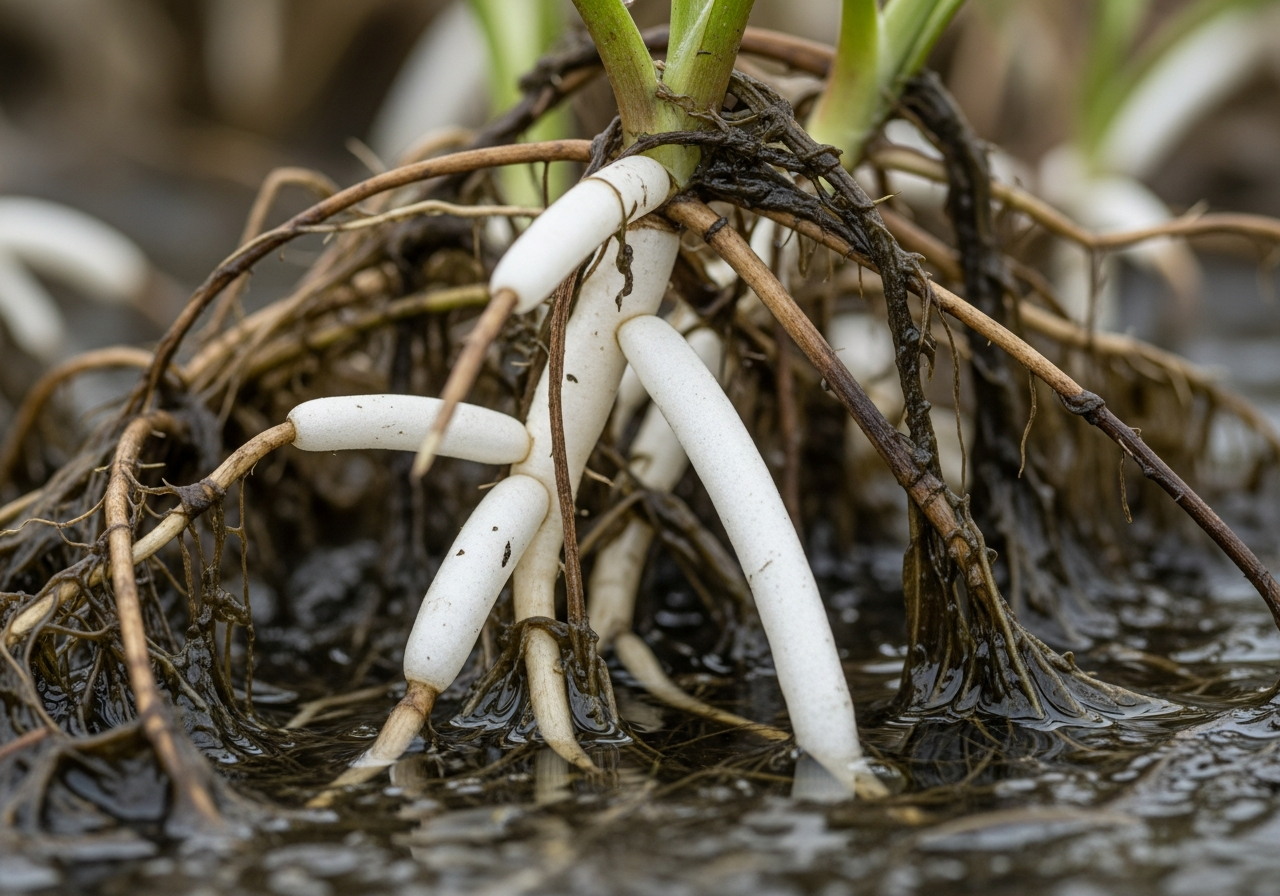
Biomass allocation patterns reveal how plants prioritize investment between structures that capture resources above-ground (shoots and leaves) versus those that anchor, store, and spread below-ground (roots and rhizomes). In L. peploides, this allocation is highly dynamic and responsive to environmental conditions.
In nutrient-poor conditions, the plant increases below-ground investment — producing longer, more extensive root systems to maximize nutrient uptake. In nutrient-rich environments such as eutrophied water bodies, it shifts allocation dramatically toward above-ground vegetative structures, capitalizing on resource abundance to build leaf area rapidly. This "optimal partitioning" strategy has been documented across multiple European populations and is consistent with foraging theory predictions for resource-limited environments.
Peak above-ground biomass production in productive European water bodies can reach 6–8 kg fresh weight per square meter by late summer — values comparable to intensive agricultural crops and far exceeding those of native competing macrophytes in the same habitats.
Rhizome Storage and Overwintering
In temperate climates, a substantial proportion of late-season biomass is reallocated to rhizomes and submerged stem bases. These storage organs accumulate carbohydrates and remain viable through winter under sediment, providing a reliable propagule source for rapid spring regrowth. This overwintering strategy decouples population persistence from seed recruitment, making eradication considerably more challenging than for purely seed-dependent annuals.
Competitive Fitness and Native Species Suppression
Competition experiments conducted in mesocosm settings consistently demonstrate the superior competitive fitness of L. peploides against native macrophytes including Myriophyllum spicatum, Potamogeton nodosus, and Phragmites australis. The competitive advantage operates through multiple mechanisms operating simultaneously.
Light competition is primary: L. peploides mats attenuate 90–99% of incident solar radiation, creating conditions of severe light limitation for submerged species. Simultaneously, the plant's rapid lateral expansion via floating stems physically overruns the above-canopy growing space of emergent competitors. Below-ground, its dense, fibrous root mat can exclude or displace native root systems from productive sediment layers.
Allelopathic interactions — chemical suppression of competing species through root exudates — have also been reported, though the evidence remains less conclusive than for physical competition mechanisms. Aqueous extracts of L. peploides root tissue have been shown to reduce germination and radicle elongation of several native macrophyte species under laboratory conditions, but the ecological significance of allelopathy under field conditions requires further investigation.
Inter-Population Variation in Fitness Traits
A critical question in invasion biology is whether invasive populations differ consistently from native-range populations in fitness-relevant traits. For L. peploides, common garden experiments — where plants from multiple source populations are grown under identical controlled conditions — reveal significant differentiation between native North American and invasive European populations.
European invasive populations consistently show higher relative growth rates, greater leaf area production, and more extensive lateral spread than North American populations grown under equivalent conditions. These differences persist across multiple growing seasons, suggesting genetic rather than purely phenotypic differentiation. The pattern is consistent with the Evolution of Increased Competitive Ability (EICA) hypothesis, which predicts that invasive populations, freed from specialist herbivores and pathogens present in the native range, should evolve increased allocation to growth and competitive traits at the expense of defenses.
Molecular analysis of European invasive populations using microsatellite markers has identified limited genetic diversity relative to native North American populations, suggesting founding events from a small number of introduction events. Despite this bottleneck, sufficient genetic variation remains to support measurable local adaptation to different European climatic conditions.
Conclusion
The fitness architecture of Ludwigia peploides represents a near-optimal combination of traits for freshwater invasion: phenotypic flexibility that permits colonization across diverse habitats, efficient clonal spread that accelerates population growth independently of seed recruitment, and competitive superiority over native species through multiple simultaneous mechanisms. Understanding these traits in detail is not merely an academic exercise — it is foundational to designing management interventions that target the biological mechanisms driving invasive success. Future research priorities include characterizing the genetic basis of key fitness traits, understanding gene flow between geographically isolated invasive populations, and evaluating how climate change may alter the fitness landscape for both invasive and native competing species.