Adaptations of Ludwigia peploides Explained
The remarkable invasive success of L. peploides is underpinned by an integrated suite of structural, physiological, and reproductive adaptations shaped by evolutionary history in the dynamic aquatic environments of subtropical America.
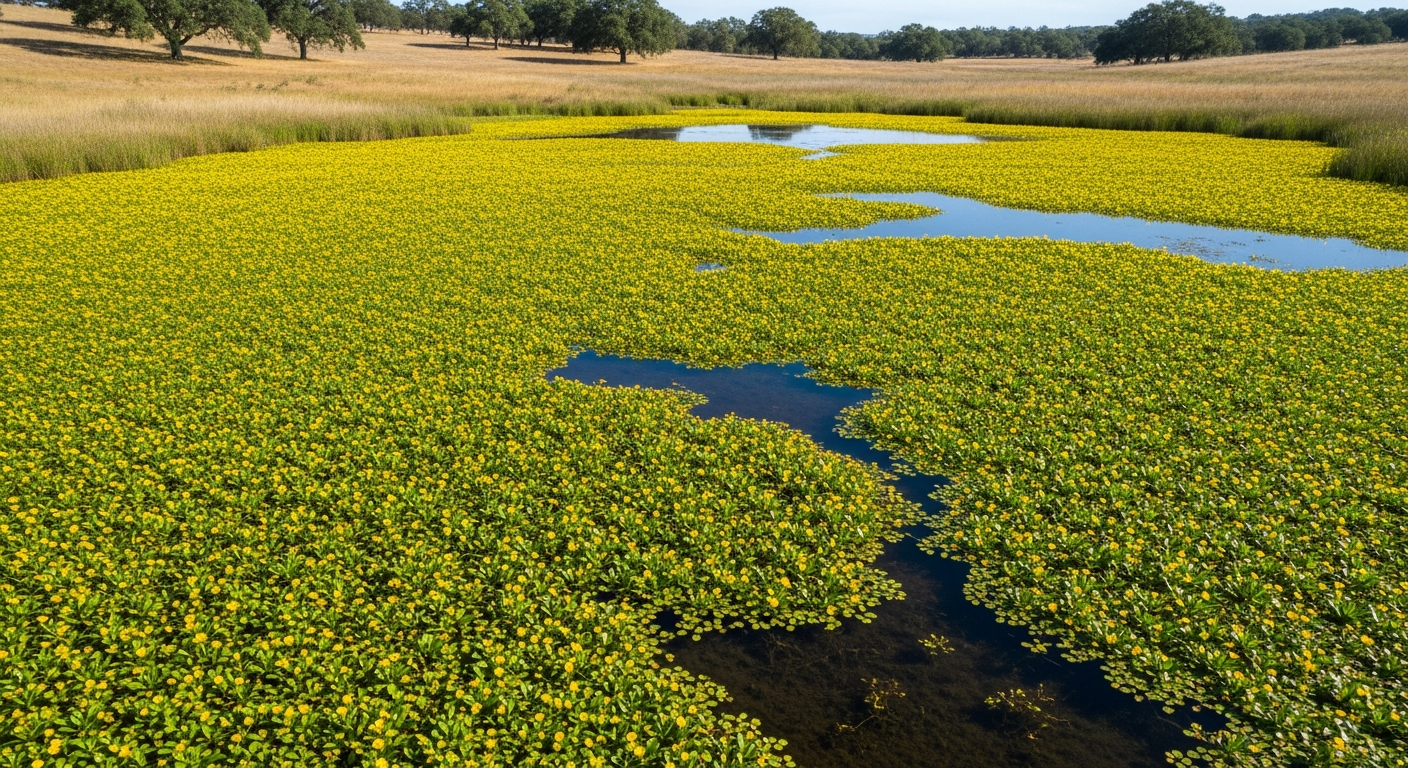
Adaptation is the process through which natural selection shapes organisms to fit the demands of their environment. In the case of Ludwigia peploides, millions of years of evolution in the hydrologically variable, nutrient-rich freshwater habitats of South and Central America have produced a plant remarkably well-equipped to exploit the conditions prevalent in disturbed, eutrophied freshwater systems globally. Understanding these adaptations not only illuminates the plant's biology but also reveals the multiple biological mechanisms that would need to be disrupted to achieve effective, lasting population control.
Structural Adaptations
Aerenchyma and Pneumatophores
The most anatomically distinctive feature of L. peploides is its aerenchyma tissue — large interconnected gas-filled spaces occupying much of the volume in stems, petioles, and roots. These spaces, formed through programmed cell death (lysigeny) or cell separation (schizogeny), create a low-resistance pathway for diffusion of atmospheric oxygen from aerial tissues to submerged organs. The resulting transport capacity can maintain aerobic respiration in root tips growing in completely anoxic sediments, a feat impossible for species lacking this specialization. Pneumatophores — the visible white spongy root structures at submerged nodes — are external manifestations of this system, acting as direct atmospheric oxygen uptake points.
Nodal Rooting System
Every node on a floating or creeping stem has the capacity to produce adventitious roots upon contact with moist substrate. This modular architecture means that each internode is effectively an independent propagule — a separate unit capable of independent growth after separation. A single 30 cm stem segment with five nodes can produce five separate plants. This structural adaptation reduces the effective propagule unit size to individual internodes, dramatically increasing the risk of reinfestation after incomplete removal.
Physiological Adaptations
Beyond structural adaptations, L. peploides possesses physiological traits that extend its ecological range. Broad thermal tolerance — active growth from approximately 12°C to 42°C — exceeds the thermal range of most native competing species in temperate regions. This permits exploitation of early spring and late autumn growing windows that are unavailable to thermophilic tropical species or lethal to cold-sensitive subtropical competitors.
Heterophylly — the production of morphologically distinct leaves in aquatic versus aerial environments — represents a sophisticated physiological adaptation. Submerged leaves are thinner, with a higher surface area:volume ratio and no functional cuticle, maximizing dissolved CO₂ and nutrient uptake from water. Emergent leaves are thicker, with a functional cuticle and stomata, optimized for gas-phase CO₂ uptake and transpiration regulation. The transition between leaf types occurs within one to two plastochrons when environmental conditions change, demonstrating rapid developmental plasticity.
Reproductive Adaptations
The combination of efficient sexual reproduction (insect-pollinated flowers producing thousands of seeds per plant per season) and highly effective vegetative propagation (nodal rooting of stem fragments) represents a particularly robust reproductive system. Sexual reproduction ensures genetic recombination and the production of dispersal-adapted seeds. Vegetative reproduction enables rapid local population growth and ensures that even genetically identical propagules from a single parent plant can colonize adjacent areas. These strategies are not redundant — they operate at different spatial and temporal scales, with seeds providing long-distance dispersal and vegetative spread driving local colonization.
Dispersal Adaptations
The species has evolved highly effective passive dispersal mechanisms. Seeds are small, buoyant, and coated with a hydrophobic waxy layer that assists water surface transport. They retain viability after passage through the digestive systems of waterfowl — particularly dabbling ducks of the genus Anas — enabling endozoochoric dispersal across hundreds of kilometers. Stem fragments are also buoyant and remain viable for weeks to months during transport by water currents. These passive dispersal traits explain the rapid colonization of new water bodies along river networks following initial establishment.
Conclusion
The adaptations of Ludwigia peploides represent an evolutionary toolkit that is ideally suited to the biological challenges of aquatic environments: oxygen limitation, hydrological disturbance, competition for light and space, and the need for both local persistence and long-distance colonization. Each major adaptation — aerenchyma for oxygen transport, modular nodal rooting for vegetative propagation, heterophylly for dual-environment function, and combined sexual-clonal reproduction — addresses a different aspect of the ecological challenges facing aquatic plants. Together, they produce one of the most formidable invasive macrophytes in global freshwater systems.